
- Home
- Products
- Hot Sales
- About Us
- Application
- Support
- News
- Contact
Views: 0 Author: Site Editor Publish Time: 2026-07-03 Origin: Site


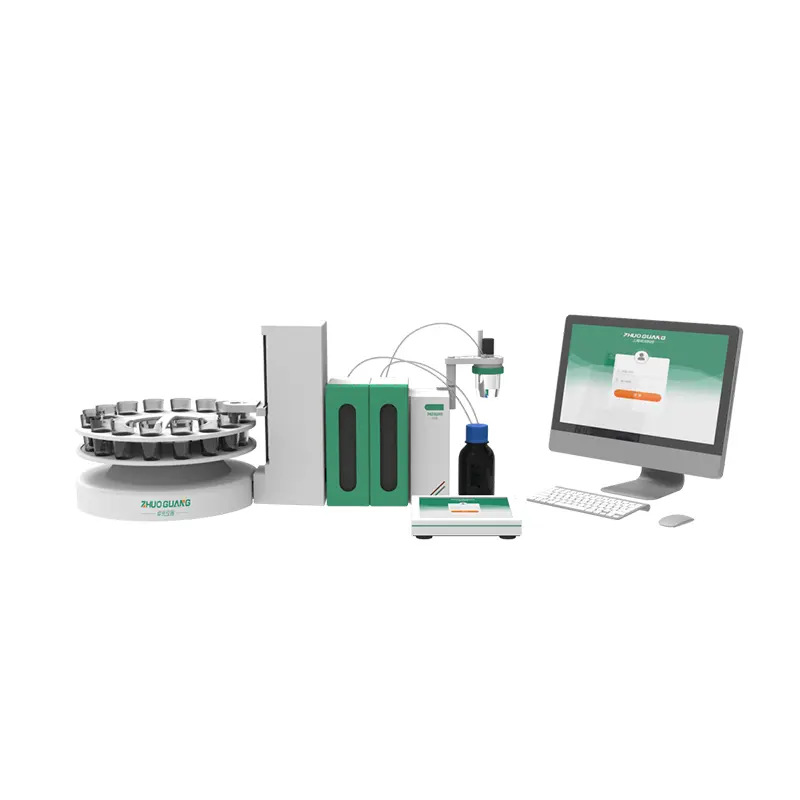
Acid-copper plating lines drift continuously as work is processed, anodes dissolve, and water evaporates. The GT80 fully automatic potential titrator with a 16-station auto-sampler is built to make those drifts visible in real time. By turning chloride, sulfuric acid and copper assays into unattended overnight runs, the instrument gives plating engineers continuous, audit-ready real-time QC data on every plating bath they operate.
Most plating shops still rely on a wet-chem technician who draws a sample once or twice per shift, walks it to a bench, and runs a manual titration. The sample is in transit, the result is being calculated, and the bath has been plating parts the whole time. By the time the supervisor can act on a concentration that has drifted out of band, parts that should never have entered the tank have already been processed. Manual workflows also suffer from operator-to-operator variance, transcription errors, and a paper trail that rarely survives a customer audit.
An automated electroplating monitoring workflow flips that sequence. The titrator draws the sample, dispenses the reagent, locates the endpoint, calculates the concentration, and writes the result to a database with no human in the loop. Combined with a standard 16-position (up to 40) sampler tray, the system can deliver true continuous real-time QC of every bath on the floor, not just a snapshot once a shift. The instrument cycle time for any single titration is parameter- and matrix-dependent; for full method timing, refer to the GT80 method sheet supplied with the application.
The business case for moving from periodic manual titration to continuous electroplating monitoring is straightforward: tighter bath control reduces additive consumption, lowers reject rates, and stabilises plating thickness distribution. Specific savings depend on the line's tank count, shift pattern, and reject history, and should be evaluated against the customer's own production data.
Acid-copper sulfate plating depends on three parameters that drift continuously during production. Each one is monitored for a specific process reason, and each one fails in a specific way when it leaves the band set by the plating engineer:
Parameter | Why It Must Be Monitored | What Goes Wrong If Uncontrolled |
|---|---|---|
Chloride ion (Cl⁻) | Promotes uniform anode dissolution, synergises with the brightener system, reduces internal stress in the deposit. | Anode passivation, copper-powder formation, rough and dull deposit. |
Sulfuric acid (H₂SO₄) | Provides bath conductivity, prevents copper-salt hydrolysis, stabilises anode dissolution. | Rising pH, copper-salt hydrolysis, porous and loose deposit. |
Copper ion (Cu²⁺) | Source of the deposited metal, sets cathode polarisation, drives throwing power. | Reduced throwing power, coarse crystals, accelerated additive consumption. |
Process control ranges for each parameter are set by the plating line's own process engineer against the formula card, and are not defined here. The parameter values shown in the next three sections are the analytical readouts produced by the GT80 on representative samples.
Chloride is the unsung hero of acid-copper plating. At the right level it promotes uniform anode dissolution, synergises with the brightener system, and reduces internal stress in the deposit. Drop too low and the anode passivates, copper powder forms, and the deposit turns rough and dull. Push too high and the bath becomes corrosive to racks, bus bars, and ancillary equipment.
The GT80 measures chloride with a silver-ion combination electrode titrated against 0.1006 mol/L silver nitrate, on a 1.0 mL sample diluted with 40 mL water. Three replicate samples of a working bath produced endpoint volumes of 0.1301 mL, 0.1296 mL and 0.1310 mL, giving chloride concentrations of 0.4636 g/L, 0.4622 g/L and 0.4672 g/L respectively. Standard deviation across the three replicates, computed directly from these readouts, is 0.0026 g/L (RSD ≈ 0.56%).
Because the silver electrode is mounted in the PTFE fluid path of the sampler head, the same electrode is used for every Cl⁻ sample in a 100-sample overnight run. The 1/48,000 resolution burette on the standard 10 mL cylinder delivers reagent in roughly 0.21 µL increments, so the endpoint is sharp and the result is reproducible across the entire batch — the foundation of trustworthy real-time QC for every plating bath on the line.
Trending chloride across a shift tells the plating engineer when the anode needs cleaning, when drag-out losses are climbing, or when makeup water is diluting the solution faster than expected. With every result written to the 300 GB internal store, those trends are available the moment the run finishes — no transcribing, no spreadsheet errors.
Sulfuric acid is what makes an acid-copper bath conductive. If the acid drops, voltage climbs, throwing power collapses, and copper salt begins to hydrolyse into insoluble basic salts that show up as roughness and porosity in the deposit. Push the acid too high and the bath becomes aggressive toward organic additives and shortens brightener life.
On the GT80, sulfuric acid is determined with a pH combination electrode and 0.5000 mol/L sodium hydroxide titrant, on a 1.0 mL sample diluted with 40 mL water. Three replicates returned endpoint volumes of 8.5542 mL, 8.5588 mL and 8.5492 mL, corresponding to acid concentrations of 4.277 g/L, 4.279 g/L and 4.275 g/L (after the standard dilution factor for the working bath). Standard deviation across the three replicates, computed directly from these readouts, is 0.0020 g/L (RSD ≈ 0.05%).
This is one of the parameters where a manual titration hurts the most. A human operator visually catches the pH jump around the equivalence point; the GT80 pH combination electrode catches the same break with 0.001 pH resolution, 24 hours a day, for every tank on the line. That is the practical difference between periodic QC and continuous electroplating monitoring.
Once the acid concentration is in the database, the system can be configured to flag any sample that falls outside a user-defined band. A continuous alarm on acid lets the bath operator add makeup acid before the next rack goes in, rather than discovering the problem at the next manual titration. For shops running multiple tanks, the same alarm logic runs in parallel across every tank in the sampler queue.
Copper is the metal being plated, so its concentration directly controls deposition rate, throwing power, and the way the brightener system behaves. Run too low and the deposit looks starved; run too high and the bath crystallises on the anode bags, additives burn out faster, and the deposit becomes coarse.
Copper on the GT80 is titrated with a copper-ion combination electrode against 0.2500 mol/L EDTA in a pH 10 ammonia buffer, on a 1.0 mL sample plus 10 mL buffer and 40 mL water. Three replicates gave endpoint volumes of 3.3221 mL, 3.3204 mL and 3.3192 mL, returning copper concentrations of 52.74 g/L, 52.70 g/L and 52.69 g/L. Standard deviation across the three replicates, computed directly from these readouts, is 0.026 g/L (RSD ≈ 0.05%).
The combination of the imported micro-detection electrode and the imported micro-syringe pump is what enables that level of repeatability. The syringe pump doses EDTA in sub-microlitre steps near the endpoint, so the inflection on the mV curve is captured precisely even at the high copper levels that overwhelm lesser instruments.
Stable copper concentration is the prerequisite for predictable additive response. Once copper is being logged on every cycle, plating engineers can correlate copper drift with brightener consumption, with Hull-cell readings, and with thickness distribution on the actual production panels — closing the loop between bath chemistry and plated quality. That correlation is the single most valuable output of a continuous monitoring program.
The chemistry is only half the story. The hardware around the instrument is what makes unattended electroplating monitoring practical in a real plating shop:
16-station standard auto-sampler (150 mL beakers), expandable to 20, 34 or 40 stations, with optional larger vessels for production-scale bath samples.
3-axis motion system with sub-millimetre positioning that can run up to 100 samples in a single unattended batch.
2-channel built-in liquid dosing, expandable to 8 channels, so the same run can add buffer, indicator and titration reagent without operator intervention.
PTFE fluid path rated for the aggressive acid-copper chemistry, eliminating the corrosion failures that plague plastic-bodied samplers.
2 USB ports, RS-232 and Ethernet for direct push of results into the LIMS or MES, with GLP-compliant PDF reports generated automatically.
300 GB internal storage for both raw data and pre-set methods, so a chloride method, an acid method and a copper method can all sit on the instrument ready to launch.
5 supported titration modes (acid-base, redox, precipitation, complexometric, non-aqueous) covering the full Cl⁻ / H₂SO₄ / Cu²⁺ panel and any related control parameter the line may add later.
Put together, this is a GT80 real-time QC monitoring platform rather than a bench instrument. To see how the same architecture is applied in other wet-chem workflows, the Zhuoguang application case library documents installations across acid-copper, nickel, zinc and wastewater streams.
Periodic manual titration captures one moment in time. Continuous monitoring captures the drift between moments, which is the information a plating engineer actually needs to keep a bath on setpoint. The instrument turns that drift into a time series by running the same three methods on the same baths, on a schedule defined by the line's standard operating procedure. For a broader view of how automatic sampling for electroplating QC fits into a modern lab, the Zhuoguang titrator category page lists comparable configurations including the GT65, GT70, GT85, GT90, GT100 and GT100B models.
Plating shops supplying automotive, aerospace or medical-device customers are increasingly required to back up bath chemistry data with the same audit trail expected of a testing lab. The GT80 is designed for exactly that environment.
Every method, every calibration, every sample run is logged to the internal 300 GB store with a full electronic signature. The instrument supports ISO 17025 technical requirements, 21 CFR Part 11 electronic-records and electronic-signature rules, FDA, GMP and GLP workflows. User accounts, password ageing, and role-based access are enforced at the method level, and the LIMS export produces reports that match the layout most auditors expect.
For a quality program that has to survive a customer audit or a regulatory inspection, that data-integrity story is the difference between a defensible monitoring program and a folder of printouts. The latest Zhuoguang news page carries the most recent updates on compliance features, firmware releases, and customer installations in regulated industries.
Frequently Asked Questions
Yes. The 5-mode titration architecture (acid-base, redox, precipitation, complexometric, non-aqueous) covers all three methods. A typical overnight sequence loads beakers once and runs chloride → acid → copper without operator intervention, with the 2-channel built-in dosing (expandable to 8 channels) handling buffer and indicator additions automatically.
Up to 100 samples per batch, run on the 3-axis motion system with sub-millimetre positioning accuracy. The standard 16-position (150 mL) tray is the most common configuration; 20, 34 and 40-position trays are available for shops running more tanks or more frequent sampling intervals. The number of samples completed in a single overnight run depends on the per-sample method time, which is set by the matrix and the titration mode.
The validation data shown in this article records three replicates of a working bath at 0.4636 / 0.4622 / 0.4672 g/L. Standard deviation across those three readouts is 0.0026 g/L, which corresponds to a relative standard deviation of about 0.56% on this particular sample set. Precision on other matrices and at other concentration levels should be confirmed by the customer against their own reference materials.
Yes. The instrument supports ISO 17025, 21 CFR Part 11, FDA, GMP and GLP workflows. Every run carries an electronic signature, user access is role-based, and the 300 GB internal store retains the full method-and-result history needed for an inspector walk-through.
Yes. The instrument exposes 2 USB ports, an RS-232 serial port and Ethernet. Results can be pushed to a LIMS in real time, exported as GLP-compliant PDF reports, or stored locally on the 300 GB drive for later batch upload — whichever fits the shop's IT environment.
Manual titrations are limited to one parameter at a time, depend on a single operator's endpoint judgement, and produce data that has to be transcribed. The titrator runs the full Cl⁻ / H₂SO₄ / Cu²⁺ panel unattended overnight, with electrode-driven endpoints, automatic reagent switching and electronic records — turning a periodic check into a continuous, audit-ready workflow for the production tank.
The instrument logs every method, calibration, and sample run to its 300 GB internal store with a full electronic signature. Access is role-based, password ageing is enforced, and the LIMS export produces reports that match the layout most auditors expect under ISO 17025 and 21 CFR Part 11.
Talk to Zhuoguang About Your Plating Bath QC Program
If you are evaluating real-time QC for an acid-copper, nickel or zinc line, the engineering team at Shanghai Zhuoguang Instrument Technology can size a configuration for your tank count and shift pattern. Send your bath matrix, sample frequency and compliance requirements to start a conversation, or browse the full GT80 product page for the complete specification sheet.


