
- Home
- Products
- Hot Sales
- About Us
- Application
- Support
- News
- Contact
Views: 0 Author: Site Editor Publish Time: 2026-07-02 Origin: Site


Choosing the right potentiometric titrator can define the throughput of your metal ion QC lab. The chemistry behind EDTA titration of Cu²⁺, Ni²⁺, Zn²⁺, or Fe³⁺ is well understood and standardized; the practical question is which Zhuoguang platform — GT80, GT65, or GT85 — fits the workload. This comparison, built around the published GT80 product page, breaks the decision down by sample volume, automation level, compliance needs, and price bracket, so you can pick the metal ion titrator that matches your batch QC reality.
For most laboratories running batch metal ion testing with a true automatic sampler, the answer points to the GT80. But the GT65 and GT85 each win in specific scenarios, and the differences between the three are far more than "just add a sample tray." Read on for the full side-by-side, three representative use cases, a 3-step decision flowchart, and the FAQ that procurement teams ask us every week.
Table of Contents
Why Choosing the Right Titrator Matters for Metal Ion QC
GT65 Single-Channel Titrator: Strengths and Limits
GT80 with Automatic Sampler: Built for Batch QC
GT85 Three-Axis Sampler System: When You Need More
Side-by-Side Comparison: GT80 vs GT65 vs GT85
3 Use Cases: Which Model Fits Your Lab?
Decision Flowchart: Pick Your Titrator in 3 Steps
FAQ
Metal ion analysis rarely fails because of the chemistry. It fails because the lab cannot keep up. EDTA titration of Cu²⁺, Ni²⁺, Zn²⁺, or Fe³⁺ is well understood, ASTM- and ISO-validated, and chemically forgiving. The bottleneck is the workflow around it: weighing, pipetting, waiting for the endpoint, recording, rinsing, and repeating. A single-channel manual titrator ties the analyst to the bench for every cycle, and that is what limits throughput — not the chemistry itself.
Multiply that by a plating line that needs regular Cu/Ni/Zn titration, or a contract lab that accepts a large queue of samples on a Monday morning, and a manual workflow collapses under its own weight. The GT80 automatic sampler was designed precisely for this kind of pressure: it parks up to 100 samples on a deck, drives a 3-axis arm at sub-millimeter precision, and keeps the analyst free for tasks the robot cannot do.
But "more automation" is not always the right answer. If your lab runs a small number of samples per week for in-process R&D, the 16-station automatic sampler is overkill, and the budget is better spent on a 2-channel benchtop. This is why we keep the GT65, GT80, and GT85 in the catalog — each occupies a real niche, and choosing the wrong one costs you twice (once on purchase, once on retrofit).
The GT65 potential titrator is Zhuoguang's workhorse single-channel benchtop unit. It is built for labs that titrate one sample at a time, do not need an automatic sampler, and want a clean dosing accuracy at an entry-level price. In a metal ion context, the GT65 is commonly used for titration of free acid in pickling baths, single-batch verification of a customer's shipment, or R&D work where the operator intentionally wants to babysit every endpoint.
What the GT65 does well: the unit is small, the touchscreen is simple, the electrode port accepts any combination of reference and indicator electrodes, and the burette drive hits 0.001 mL resolution (per spec sheet). For low-throughput metal ion work, the GT65 gives you everything a manual titration gives you, only faster and more reproducible.
Where the GT65 hits its ceiling: there is no automatic sampler, no multi-position tray, and no built-in way to chain a second analytical channel. The moment your sample queue grows beyond what a single analyst can babysit in a shift, the analyst becomes the bottleneck. The GT65 also lacks native 21 CFR Part 11 electronic signature hooks, so pharmaceutical or medical-device QC labs on regulated audit cycles will outgrow it quickly.
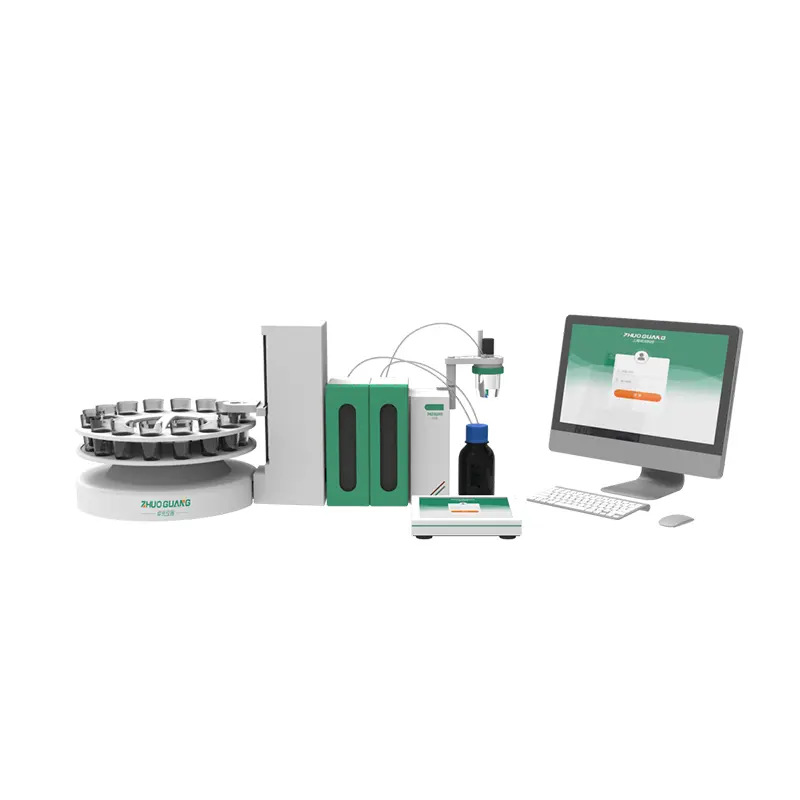
The GT80 fully automatic potential titrator with automatic sampler for mass determination is the unit you reach for when batch metal ion testing is the daily reality. It pairs Zhuoguang's 2-channel high-precision titrator core with a 16-position (expandable to 20, 34, or 40) automatic sample tray, a 3-axis motion system, and a 300 GB onboard database for methods and results. The combination is purpose-built for high-throughput metal ion QC in plating, alloy, environmental, and pharmaceutical labs. The automatic sampler architecture is the single biggest differentiator between the GT80 and any single-channel metal ion titrator on the market.
Hardware that matters in a metal ion lab (per the GT80 product page):
Measurement range: -2000.0 mV to +2000.0 mV, and -20.000 pH to +20.000 pH, with 0.1 mV / 0.001 pH resolution and ±0.03% mV / 0.003 pH accuracy — covers the redox and complexometric endpoints you will meet in a Cu/Ni/Zn/Fe titration.
5 titration modes: acid-base, redox, precipitation, complexometric, and non-aqueous — the complexometric mode is what drives the EDTA titration of metal ions.
2 built-in liquid-addition channels + 8 expandable: lets you dose buffer, masking agent (e.g., ammonia for Cu/Ni), indicator, and back-titrant from separate burettes without manual intervention.
250 mL titration beaker + PTFE fluid path: corrosion-proof against chloride, ammonia, and ammonium chloride matrices common in metal ion work.
Temperature probe: -20 to 135 °C, 0.01 °C resolution, ±0.1 °C accuracy — critical because EDTA endpoint drift with temperature is a real source of error.
Burette drive: 1 / 5 / 10 / 25 / 50 mL interchangeable burettes, 10 mL standard, 1/48,000 step resolution, 10 s 100% fill time.
Imported micro-detection electrode + imported micro-syringe pump: the combination that lets the system detect micro-volume endpoints with the same precision a manual titration gives, only across unattended sample batches.
Throughput that actually scales: the standard 16-position tray (150 mL vials) is the sweet spot for plating baths and alloy QC. The optional 20, 34, or 40-position trays let a single GT80 automatic sampler run a full unattended batch — up to 100 samples in queue — and the run length is set by method complexity, not by an operator's shift schedule. The 3-axis arm parks at sub-millimeter accuracy, so even micro-titration beakers land cleanly every cycle. Two USB ports, RS-232, and Ethernet come standard for LIMS push, printer hookup, and CSV export.
Compliance built in: the GT80 ships with ISO 17025, FDA, GMP, GLP, and 21 CFR Part 11 audit-trail support — meaning electronic signatures, role-based access, and tamper-evident logs are native, not an aftermarket add-on. For a regulated metal ion lab (pharma excipients, medical-device coatings, food-contact alloys), this alone can decide the purchase.
For most batch metal ion buyers in 2025, the GT80 is the default recommendation. Browse the full GT80 product page to download the spec sheet and method library.
The GT85 mass determination titrator sits one tier above the GT80 in the Zhuoguang line. As its name suggests, it is the "mass determination" / heavier-workload member of the GT family, with a multi-axis automatic sampler architecture designed for the most demanding batch metal ion workloads — the kind of work where the GT80's standard 16-position tray is no longer enough and where the lab needs more flexible deck geometry, more vial sizes on one run, and the option to chain multiple chemistries without manual reset. For full GT85 specifications, refer to the linked GT85 product page.
Where the GT85 earns its place: if your metal ion method requires three or more dosing reagents in sequence (e.g., add buffer → add masking agent → back-titrate with EDTA), the GT85's 3-axis arm can visit multiple burette stations in one method, where a simpler single-arm automatic sampler would force a manual reset. The GT85 is also a better fit for labs that run mixed-method batches — e.g., a tray of Cu titrations followed by Ni titrations, with the robot switching electrodes and reagents between them.
Where the GT80 is the better buy: if your metal ion work is a single, repeatable method (EDTA titration of Cu, Ni, Zn, or Fe), and your daily sample count is in the tens to roughly a hundred, the GT80 hits the same accuracy, the same 3-axis precision, and the same compliance footprint at a lower entry price. The GT85 is the right tool when the workload justifies its premium — and not before. The 2-channel core and the 16-station baseline tray are the same on both; what changes is the deck flexibility and the configurability ceiling.
Below is the consolidated spec-and-feature comparison across the three Zhuoguang models most often shortlisted for metal ion titration. GT80 specs are taken from the published product page; GT65 and GT85 entries are intentionally limited to published spec data only, with qualitative notes for items that vary by configuration.
Specification / Feature | GT65 (Single-Channel) | GT80 (Batch QC) | GT85 (High-Volume Batch) |
|---|---|---|---|
Automatic sampler | ❌ None | ✅ 16-station standard; 20 / 34 / 40 optional (150 mL vials) | ✅ Multi-axis automatic sampler system |
Channel count | 1 channel | 2 built-in liquid-addition channels + 8 expandable | 2 channels, high-capacity deck |
Max batch size | 1 sample at a time | Up to 100 samples in queue | Large batch, mixed-method capable |
Motion system | n/a (manual sample placement) | 3-axis, sub-millimeter positioning | 3-axis, high-flexibility deck |
Dosing resolution | 0.001 mL | 0.001 mL (1/48,000 step) | 0.001 mL |
Burette options | Interchangeable burettes (sizes per spec sheet) | Interchangeable 1 / 5 / 10 / 25 / 50 mL (10 mL std.) | Interchangeable burettes (sizes per spec sheet) |
Measurement range | mV / pH, lab-grade | -2000.0 to +2000.0 mV; -20.000 to +20.000 pH | mV / pH, lab-grade |
Resolution / accuracy | 0.1 mV / 0.001 pH | 0.1 mV / ±0.03% mV; 0.001 pH / 0.003 pH | 0.1 mV / 0.001 pH |
Titration modes | Acid-base, redox, precipitation, complexometric, non-aqueous | Acid-base, redox, precipitation, complexometric, non-aqueous | Acid-base, redox, precipitation, complexometric, non-aqueous |
Beaker capacity | Standard | 250 mL | 250 mL |
Temperature probe | Optional | -20 to 135 °C, 0.01 °C resolution, ±0.1 °C accuracy | Lab-grade temperature input |
Fluid path | Chemical-resistant | PTFE (corrosion-proof) | Chemical-resistant (per spec sheet) |
Electrode | Standard combination electrode | Imported micro-detection electrode + micro-syringe pump | Imported combination electrode (per spec sheet) |
Storage | Methods + results, standard | 300 GB (methods + results) | Large onboard storage |
Communication | USB | 2× USB + RS-232 + Ethernet | USB + Ethernet (per spec sheet) |
Compliance | Standard | ISO 17025, 21 CFR Part 11, FDA, GMP, GLP | Standard to advanced compliance |
Ideal workload | Low-volume metal ion QC | High-volume metal ion QC, regulated labs | Highest-volume metal ion QC, mixed methods |
Price tier | Entry / economy | Mid-to-high | High-end |
Three things stand out. First, only the GT80 and GT85 have a true automatic sampler; the GT65 is a manual-placement titrator. Second, the GT80 publishes the full 21 CFR Part 11 + ISO 17025 + FDA + GMP + GLP compliance list in its standard config, which matters for regulated metal ion QC. Third, the burette resolution, titration modes, and core accuracy are the same across all three — so the choice is really about automation and throughput, not about chemistry capability.
If you are cross-shopping against the GT70 (our 2-channel mid-tier), the GT80 is essentially the GT70 plus a factory-integrated 16-station automatic sampler. See the GT70 page if you want to understand the lineage; the GT80 is where the line crosses from "benchtop with two burettes" into "walk-away batch system."
The fastest way to pick between the GT80, GT65, and GT85 is to look at your actual daily load. Here are three representative metal ion QC scenarios we see in customer inquiries. Sample-count thresholds are intentionally omitted — the right model depends on your method complexity, matrix, and compliance regime, not on a single number.
Use Case 1 — Small plating shop, low-volume metal ion QC.
You run a job-shop plating line with a handful of Ni and Cu baths. Each shift produces a few titration samples for verification. The chemistry is well understood, the analyst is experienced, and the budget is tight. The GT65 is the right tool for this metal ion workload. The 0.001 mL burette drive gives you the precision the method needs, the footprint fits on a corner bench, and the per-sample cost of ownership is the lowest in the line. Adding a GT80 here would burn budget on a 16-station tray you would never fill. The GT65 simply is the most cost-effective metal ion titrator for low-volume, single-batch operation.
Use Case 2 — Regulated metal ion QC lab, medium-to-high daily volume.
You are a contract lab serving pharmaceutical, food-contact, or medical-device customers. Your metal ion workload includes Cu, Ni, Zn, Fe, Cr, and Pb across diverse matrices. You need electronic signatures, full audit trails, and 21 CFR Part 11 compliance. You need a sample tray the analyst can load and walk away from. This is the GT80 sweet spot. The 16-station standard tray (or 20 / 34 / 40 upgrade) covers the workload, the PTFE fluid path tolerates aggressive matrices, and the regulatory package is built in. The GT65 will not pass the audit, and the GT85 is over-spec for the volume.
Use Case 3 — Large environmental / alloy lab, high-volume mixed-method metal ion QC.
You run a high-throughput environmental lab or an alloy producer that needs many metal ion titrations per day across multiple methods — Cu today, Ni tomorrow, alloy compositional analysis the day after. You need a 3-axis arm that can switch burettes, electrodes, and reagents between methods without an operator reset. You need the flexibility to load a mixed tray. This is the GT85 workload. The GT80's 16-station tray would force you to break the queue into smaller, method-homogeneous batches; the GT85's flexible deck removes that constraint. For mixed-method metal ion workflows at the top of the Zhuoguang range, the GT85 is the only model that scales without manual reset.
Reference data point (for context only): the metal ion titration numbers we see in the field follow ASTM and ISO standard methods. For copper by EDTA at pH 10 with ammonium chloride / ammonia buffer, typical end-point volumes fall in the low single-digit mL range for a 1 mL sample diluted to 40 mL — the exact volume depends on concentration, burette size, and matrix. Use the published method as the source of truth, not a generic number.
If you have read this far and still want a one-page decision rule, here it is. Answer three questions in order. The right answer depends on your method complexity and compliance regime, not on a single sample-count threshold.
Step 1 — How does your lab use the titrator?
One sample at a time, analyst-driven, no audit-trail requirement → go to Step 2a. You want to leave the tray loaded and walk away → go to Step 2b. You need mixed-method runs on a single deck → go to Step 2c.
Step 2a — Manual titrator, no audit trail.
The GT65 is the right tool. Single-channel, no automatic sampler, lowest cost of ownership. If you ever move to a regulated environment, plan to upgrade to the GT80 for compliance, not to stay on the GT65 with add-ons.
Step 2b — Walk-away batch QC, single repeatable method.
The GT80 is the right tool. Factory-integrated 16-station automatic sampler, 3-axis motion, full 21 CFR Part 11 compliance package. The optional 20 / 34 / 40-position trays extend unattended run length as your method complexity allows.
Step 2c — Mixed methods, multi-reagent sequences, top of the range.
The GT85 is the right tool. Higher-flexibility 3-axis deck, same 0.001 mL burette resolution as the GT80, built for the most demanding batch metal ion workloads. The GT85 premium pays for deck flexibility, not for a different chemistry core.
Step 3 — Confirm compliance and support.
Whichever way you land, confirm that the model ships with the compliance list your auditor requires (ISO 17025, 21 CFR Part 11, FDA, GMP, GLP) and that the local distributor can support method development on the platform. For the GT80, GT65, and GT85, all three are backed by Zhuoguang's global service network; the GT80 and GT85 are the only two in the line that include 21 CFR Part 11 as standard, and the GT65 and GT80 share the same 0.001 mL burette drive and the same five titration modes.
When in doubt, contact us with your daily sample count, matrix, and target analytes, and we will tell you straight whether the GT65, GT80, or GT85 is the right fit. Most regulated metal ion labs land on the GT80 automatic sampler.
FAQ 1 — What is the main difference between the GT80 and the GT65 for metal ion testing?
The GT65 is a single-channel benchtop titrator with no automatic sampler — the operator places one sample at a time. The GT80 adds a factory-integrated 16-position automatic sampler (expandable to 20 / 34 / 40), a 3-axis motion system, and walk-away batch capacity of up to 100 metal ion samples. Both share the same 0.001 mL burette resolution and the same five titration modes; the difference is throughput and automation, not chemistry. In short: the GT65 is a manual titrator, the GT80 is a batch automatic sampler system.
FAQ 2 — When should I choose the GT85 over the GT80 for batch metal ion work?
Choose the GT85 when your metal ion workload requires mixed methods on a single tray (e.g., Cu titration followed by Ni titration with electrode and reagent swaps), when you need the highest deck flexibility the Zhuoguang line offers, or when your daily sample volume sits at the top of the GT80's range and you want a more flexible 3-axis deck. For most labs running a single repeatable method (EDTA titration of Cu / Ni / Zn / Fe), the GT80 is the more cost-effective choice. The GT85 and the GT80 share the same 0.001 mL burette drive and the same automatic sampler mechanics; the GT85's premium pays for the more flexible 3-axis deck.
FAQ 3 — Does the GT80 automatic sampler support 21 CFR Part 11 and FDA compliance?
Yes. The GT80 ships with ISO 17025, 21 CFR Part 11, FDA, GMP, and GLP compliance as standard, including electronic signatures, role-based access, and tamper-evident audit trails. This makes the GT80 a common choice for pharmaceutical, medical-device, and food-contact metal ion QC labs that face regular regulatory audits. The GT65 does not include 21 CFR Part 11 in its standard config, and the GT85 includes the same compliance package as the GT80.
FAQ 4 — How many samples can the GT80 run unattended in a single batch?
Up to 100 samples in a single queue. The standard 16-position tray (150 mL vials) covers a typical shift, and the optional 20, 34, or 40-position trays extend a single unattended run, with run length set by method complexity and sample count. Methods and results are stored on the 300 GB onboard drive for later review and LIMS export. The GT85 handles a comparable per-tray capacity, but with a more flexible deck layout for mixed-method metal ion runs.
FAQ 5 — Can the GT65 be upgraded to an automatic sampler later?
No. The GT65 is designed as a single-channel manual-placement unit, and the platform does not support a field upgrade to a GT80-class automatic sampler deck. If your metal ion workload is likely to grow to medium or high volume — or if you anticipate moving to a regulated environment — the GT80 is the safer purchase even at lower current volume.
FAQ 6 — Which metal ion methods are supported on the GT80 and GT85?
Both the GT80 and GT85 support the five core titration modes: acid-base, redox, precipitation, complexometric, and non-aqueous. For metal ion analysis, the complexometric mode (EDTA titration) is the workhorse for Cu²⁺, Ni²⁺, Zn²⁺, Fe³⁺, Ca²⁺, Mg²⁺, and similar analytes. The redox mode covers Ce⁴⁺, Cr(VI), Mn, and Fe(II)/Fe(III) redox titrations. The precipitation mode handles halides and argentometric methods. Method templates for these metal ion assays ship with the unit and can be edited on the touchscreen or in the PC software. The GT65 supports the same five modes on a single-channel platform.
FAQ 7 — What service and method-development support does Zhuoguang provide for the GT80?
Zhuoguang Instrument provides factory warranty on the GT80, GT65, and GT85 titrators, with extended warranty and on-site service contracts available on request. Application support — including method development for new metal ion assays — is available for the lifetime of the instrument. Contact our sales team for a region-specific service quote, including method-feasibility review and method-transfer assistance.
Ready to spec the right titrator for your metal ion QC line?
Send us your daily sample count, target analytes, and matrix — we will recommend the GT65, GT80, or GT85, with a formal quote and a method-feasibility note.


