
- Home
- Products
- Hot Sales
- About Us
- Application
- Support
- News
- Contact
Views: 0 Author: Site Editor Publish Time: 2026-07-01 Origin: Site


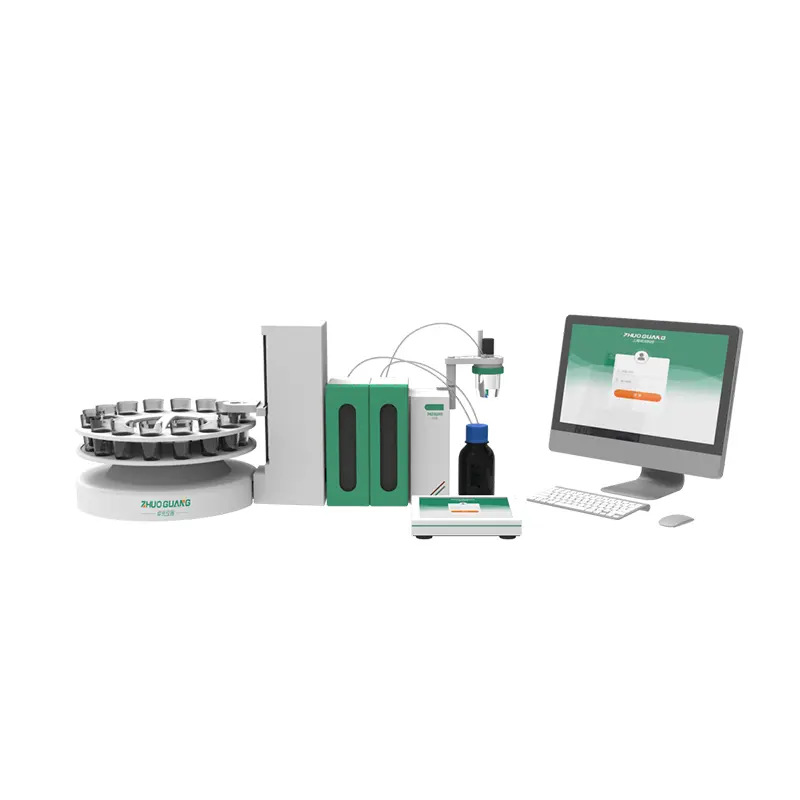
If you run a plating line, you already know the chemistry never sits still. Chloride drifts, sulfuric acid gets consumed, copper builds up on the brightener side, and by the time your shift chemist finishes the day-shift titration queue, the bath has moved on. For QA managers who need chloride, free acid and copper ion numbers on a routine schedule, the bottleneck is rarely the method itself; it is the time it takes to do cup after cup on the bench. The GT80 automatic potential titrator with its 16-station auto-sampler is built for exactly this kind of workload. This guide walks through how the GT80 turns three routine electroplating titrations (chloride, free sulfuric acid, copper ion) into a single unattended batch run, using only validated reagent sets, a PC and one operator.
Manual titrations in a plating lab usually mean one analyst, one beaker, one burette, and a stopwatch. The analyst has to weigh or pipette the sample, dilute it, position the electrode, watch the burette meniscus, record the endpoint, rinse the electrode and write the result down before moving to the next cup. The exact time depends on the bath matrix, the analyst's experience, and the parameter being titrated, but the workflow itself does not change. Multiply that by the sample count a production plating line needs every shift and the bench becomes the limiting factor in the QC loop.
Add the other two parameters that the same bath needs and the workload compounds. A typical bright acid copper or acid tin line is expected to control chloride, free sulfuric acid and copper sulfate in tight bands, and the exact bands are defined by the brightener supplier formulation in use. Walking away from manual analysis is not just a question of speed, it is also a question of traceability. Every hand-poured titration introduces parallax, burette reading and timing variability that show up as scatter on the QC chart and force the analyst to run more replicates to clear the spec.
This is where a fully automatic potential titrator with a built-in auto-sampler changes the workflow. The instrument pulls the sample, doses the titrant at 0.001 mL resolution, watches the electrode curve, locates the equivalence point and writes the result into a 300 GB audit-trailed database, all without the analyst touching the beaker after loading. What used to be a working day on the bench becomes an unattended job the QC team can review in the morning.
It is engineered around a 3-axis motion system with sub-millimeter positioning accuracy, which is what allows the sampling needle to dock reliably with 16 individual 150 mL beakers arranged on the sampler tray. Up to 100 samples can be queued in a single run, distributed across 16, 20, 34 or 40 position racks depending on the workload pattern. That flexibility is one of the main reasons plating labs standardize on this model rather than single-sample units like the GT65 or GT85.
Specification | GT80 Value |
|---|---|
Measurement range | -2000.0 mV to +2000.0 mV; -20.000 pH to +20.000 pH |
mV resolution / accuracy | 0.1 mV, ±0.03% |
pH resolution / accuracy | 0.001 pH, 0.003 pH |
Burette resolution | 1 / 48,000 of burette volume (10 mL standard) |
Dosing precision | 0.001 mL per step |
Titration modes | Acid-base, redox, precipitation, complexometric, non-aqueous |
Beaker capacity | 250 mL |
Temperature range | -20 to 135 °C, 0.01 °C resolution, ±0.1 °C accuracy |
Liquid dosing | 2 channels built-in + 8 channels expandable |
Burette sizes | 1 / 5 / 10 / 25 / 50 mL (10 mL standard) |
Filling time | 10 s for 100% fill |
Auto-sampler | 16 stations (150 mL), optional 20 / 34 / 40 stations |
Batch capacity | Up to 100 samples per run, sub-millimeter positioning |
Interfaces | 2× USB, RS-232, Ethernet; LIMS export |
Compliance | ISO 17025, 21 CFR Part 11, FDA, GMP, GLP |
Fluid path | PTFE tubing, burette and rotary valve, corrosion-proof |
Data storage | 300 GB on-board, audit trail, role-based access, e-signature |
Two specifications are particularly important for plating labs running aggressive acidic matrices. The first is the PTFE fluid path, which keeps the 0.5 mol/L sodium hydroxide, the 0.1 mol/L silver nitrate and the 0.25 mol/L EDTA solutions from attacking the burette, rotary valve or dosing lines during hundreds of cycles. The second is the five-mode titration engine, because chloride uses precipitation, sulfuric acid uses acid-base neutralization and copper uses complexometric chemistry, and the same instrument needs to handle all three without any hardware swap.
Chloride in a plating bath is the classic example of a parameter that must stay inside a narrow band. Too little chloride and the anode passivates, brightener synergy collapses and the deposit turns rough. Too much chloride and the deposit picks up internal stress, pitting risk rises and the brightener consumption curve drifts off the standard profile. The standard method on the GT80 with automatic sampler uses a silver-ion combination electrode and 0.1006 mol/L silver nitrate as the titrant.
The reaction is straightforward: Ag⁻ + Cl⁻ → AgCl↓. The silver electrode tracks the mV jump at the equivalence point, and the GT80 records the inflection automatically. For each sample, the analyst pre-programs the following steps on the 16-station tray:
Pipette 1.0 mL of filtered plating bath into a clean 150 mL beaker.
Add 40 mL of deionized water to lower the ionic strength and stabilize the electrode response.
Place the beaker in position 1 through 16, and let the GT80 sampler load the silver combination electrode.
Run the precipitation titration with a 10 mL burette dosing 0.1006 mol/L AgNO₃ in 0.001 mL increments until the mV endpoint is detected.
Validation runs on a standard chloride spike solution deliver endpoints of 0.1301, 0.1296 and 0.1310 mL across three replicates, which calculate to 0.4636, 0.4622 and 0.4672 g/L of chloride in the bath. Running the same method on the GT80 in batch mode means the analyst only has to load the tray, press Start, and review the curves the next morning. The exact time per tray depends on the bath matrix, the chosen electrode conditioning and the rinse protocol, but the analyst hands-on time per parameter is reduced to a single tray-loading step.
Free sulfuric acid is the conductivity workhorse of acid copper, acid tin and many decorative plating baths. It keeps the metal salt soluble, prevents hydrolysis of the brightener, raises cathode current efficiency and stabilizes anode dissolution. When the free acid drops, the bath throws poorly, the deposit dulls, and the brightener load has to be increased just to compensate. That is why free acid is on almost every plating QC checklist, usually at least once per shift.
On this instrument the free acid is titrated with 0.5000 mol/L sodium hydroxide standard solution using an aqueous pH combination electrode, on the same auto-sampler tray used for chloride. The reaction is the classic strong acid / strong base neutralization H₂SO₄ + 2 NaOH → Na₂SO₄ + 2 H₂O, and the pH electrode registers the sharp break at the second equivalence point. A typical method file on the instrument is:
Pipette 1.0 mL of filtered bath into a 150 mL beaker.
Add 40 mL of deionized water and place the beaker in the auto-sampler tray.
Select the 10 mL burette, 0.5000 mol/L NaOH, 0.001 mL increment, pH electrode endpoint at the second derivative maximum.
Start the run, the GT80 calculates free H₂SO₄ in g/L directly from the formula editor and writes the result to the audit trail.
Validation runs on a standard bath give endpoints of 8.5542, 8.5588 and 8.5492 mL across three replicates, which calculate to 4.277, 4.279 and 4.275 g/L of free sulfuric acid. The 1/48,000 burette resolution eliminates the parallax error that dominates hand-bench titrations. The same tray can be re-used for the next production tank as soon as the audit log is signed off, so multi-tank facilities can stack the free-acid method behind the chloride method on a single overnight queue.
Copper sulfate is the deposition source itself. If the copper concentration drops, the cathode polarization falls, the deposit becomes coarse and the throwing power collapses. If it climbs too high, copper salts crystallize in the bath corners, drag-out losses explode and the rinse water load increases. Either way, copper ion has to be tracked just as tightly as the free acid and chloride.
The GT80 measures copper by complexometric titration with 0.2500 mol/L EDTA standard solution at pH 10, using an ammonium-ammonia chloride buffer and a copper ion combination electrode. The reaction is Cu²⁺ + Y¹⁹²⁻ → CuY²⁻. The mV jump at the equivalence point is sharp and unambiguous. The standard method file is:
Pipette 1.0 mL of filtered plating bath into a 150 mL beaker.
Add 10 mL of pH 10 ammonium-ammonia chloride buffer, then 40 mL of deionized water.
Place the beaker in the auto-sampler tray and select the copper combination electrode.
Titrate with 0.2500 mol/L EDTA, 10 mL burette, 0.001 mL increment, endpoint on mV second derivative.
Validation runs on a standard bath give endpoints of 3.3221, 3.3204 and 3.3192 mL across three replicates, which calculate to 52.74, 52.70 and 52.69 g/L of copper. The same instrument handles the EDTA reagent and the pH 10 buffer through the same PTFE fluid path used for chloride and acid. Once the analyst has built the three method files in the GT80 software, switching from one parameter to the next between trays is a single click in the queue editor.
The real efficiency of the GT80 is not in any single titration, it is in the way the three methods stack into one unattended batch. A typical workflow in a copper plating lab looks like this. The QC technician programs the GT80 software with the three methods in sequence: chloride on the first tray, free acid on the second tray, copper on the third tray. All three methods share the same auto-sampler, the same electrode carousel and the same audit trail; only the electrode, the burette reagent and the calculation formula change between methods, and the software switches all three automatically.
From there, the analyst pre-pipettes the beakers in advance, loads them onto the tray, and presses Start. The GT80 runs the queue unattended, logging every mV curve, every reagent addition, every operator action and every calculation step under the 21 CFR Part 11 electronic signature framework. The next morning, the analyst reviews the curves, signs the batch and releases the data to LIMS. Total analyst hands-on time is limited to the tray-loading and the morning review; the instrument itself runs through the night. Compared with a manual lab running the same workload, the saving is concentrated in bench hours rather than in any one parameter's run time.
For multi-tank facilities running 8 to 12 plating baths, the practical benefit is that the GT80 allows the lab to test every tank on every parameter every shift, which is rarely possible with manual workflows. The exact payback depends on the local labor cost, the shift pattern and the audit overhead, and should be evaluated against the specific QC contract in place.
To make the difference explicit, the table below compares the same three methods run on a single-position titrator against the GT80 in 16-position batch mode. The numbers in the audit-trail and compliance rows are taken from the GT80 specification sheet; the per-tray throughput values are deliberately left as ranges that depend on the bath matrix and the chosen method, rather than fixed engineering numbers, because real-world plating baths vary widely in ionic strength, additive load and required rinse steps.
Dimension | Single-sample mode (GT65 / GT85 in manual mode) | GT80 batch mode (16-station auto-sampler) |
|---|---|---|
Samples per analyst session | One beaker at a time, batch size limited by analyst stamina | Up to 100 samples queued in a single run |
Analyst hands-on time per parameter | Every sample needs manual pipetting, endpoint reading and recording | Tray loading once, then walk-away; review the curves the next morning |
Per-tray throughput | Limited by analyst speed, matrix complexity and method kinetics | Limited by method kinetics and electrode conditioning; the auto-sampler removes the analyst-bottleneck |
Endpoint recording | Handwritten logbook or spreadsheet | 300 GB on-board, mV curve, calculation formula, operator ID, e-signature |
Audit trail coverage | Manual entries only | 21 CFR Part 11 compliant: role-based access, full change history, e-signature |
Electrode change between methods | Manual disconnect / reconnect / re-calibrate | Automatic electrode switch handled by the software between queued methods |
Multi-tank scalability | Each additional tank adds linear analyst time | Additional tanks add tray-loading time only, the queue handles the rest unattended |
What does not change between the two modes is the underlying chemistry: chloride still uses silver nitrate, free acid still uses sodium hydroxide, copper still uses EDTA at pH 10. What changes is the workflow. Batch mode gives the lab the ability to run all three parameters on every tank, every shift, without expanding the QC headcount, and to keep every result inside the same audit trail from the moment the beaker is loaded to the moment the LIMS record is signed.
1. Can one GT80 run all three titrations (Cl⁻, H₂SO₄, Cu²⁺) on the same auto-sampler tray?
Yes. The auto-sampler carries the beaker from station to station, and the software switches the electrode and the burette reagent between methods. Most labs program chloride, acid and copper as three sequential methods on a single tray; the instrument handles electrode change, reagent refill and rinse between methods automatically.
2. How many plating samples can the GT80 process in one batch?
Up to 100 samples per run, distributed across 16, 20, 34 or 40 position racks. The 16-station rack ships standard; 20, 34 and 40 position racks are optional for high-volume labs running close to the 100-sample daily ceiling on a single parameter.
3. Does the GT80 meet ISO 17025 and 21 CFR Part 11 audit requirements?
Yes. The instrument is designed for ISO 17025, 21 CFR Part 11, FDA, GMP and GLP environments. It provides role-based user access, complete audit trail, electronic signature on every result, and 300 GB of on-board storage for raw curves and reports.
4. Which electrodes are used for the three plating titrations?
Chloride uses a silver-ion combination electrode with 0.1006 mol/L silver nitrate. Free sulfuric acid uses an aqueous pH combination electrode with 0.5000 mol/L sodium hydroxide. Copper uses a copper-ion combination electrode with 0.2500 mol/L EDTA and pH 10 ammonium buffer. The system stores calibration data for all three electrodes.
5. How long does a 16-sample batch take on the GT80?
The exact time depends on the bath matrix, the chosen electrode conditioning protocol, and the rinse steps between methods. In practice, EDTA complexometric titrations take longer per sample than the silver-nitrate precipitation reaction, so the copper method usually sets the per-tray pace. The analyst hands-on time is limited to the tray-loading step at the start of the run.
6. Can the GT80 connect to a LIMS or factory MES system?
Yes. The instrument ships with two USB ports, one RS-232 serial port and an Ethernet port. The PC software exports results as CSV, PDF or LIMS-compatible XML; the 300 GB internal drive also stores raw mV curves for any retrospective re-calculation that auditors may request.
7. Is the fluid path resistant to strong acids like sulfuric acid?
All wetted parts, including the burette, the rotary valve and the dosing tubing, are PTFE. The instrument is rated for continuous contact with 0.5 mol/L NaOH, 0.1 mol/L AgNO₃, 0.25 mol/L EDTA and sulfuric acid matrices up to concentrated acid-copper working strength. There is no metal contact between the sample and the fluid path.
8. How does the GT80 differ from the GT65 or GT85 in plating applications?
The GT65 is a single-sample, single-method workhorse for low-volume QA. The GT85 is the single-sample high-end model for research and method development. The GT80 adds the 16-station auto-sampler and the 100-sample batch engine, which is what makes it the right choice for production plating labs that have to test multiple tanks per shift.
Need a quotation or a method file for chloride, free acid and copper ion batch titration on plating baths? Contact Zhuoguang Instrument with your tank volume, sample count per shift and target control limits, and the application team will return a configured GT80 quote within one working day. Visit the Application Cases page for more plating, mining and water-treatment titration workflows on the GT80 fully automatic potential titrator.


