
- Home
- Products
- Hot Sales
- About Us
- Application
- Support
- News
- Contact
Views: 0 Author: Site Editor Publish Time: 2026-08-01 Origin: Site


Lubricating oil quality cannot be judged by appearance or viscosity alone. Density provides another useful physical indicator for checking whether raw materials, blends, and finished batches remain consistent with an established formulation. Because density changes with temperature and can also be distorted by bubbles, residue, or poor sampling, the measurement process matters as much as the number itself. The ZG-MD80 Fully Automatic Liquid Density Meter combines controlled-temperature U-tube measurement with automated sample handling, helping laboratories make density testing a more repeatable part of lubricant quality control.
Density expresses the mass contained in a given volume of liquid. For lubricating oils, that simple physical property can provide a useful consistency check because base oils, additive packages, and finished formulations each have characteristic density behavior under defined test conditions. Density measurement can therefore support routine comparison of incoming materials, blended products, and retained reference samples. Used consistently, it helps laboratories identify changes that may not be apparent from appearance alone.
The main value is not that one density number proves an oil is acceptable. Instead, the value becomes meaningful when it is compared with an approved formulation, historical batch data, or an internal specification measured at the same temperature. An unexpected shift may indicate a different raw-material ratio, incomplete blending, contamination, formulation error, or another process change that deserves investigation. A result outside the expected range does not identify the cause by itself, so density should work alongside viscosity, water content, acid or base number, elemental analysis, and other tests appropriate to the lubricant.
Density also matters when volume and mass must be related. Petroleum liquids expand and contract as temperature changes, meaning an uncontrolled-temperature measurement can create misleading comparisons between otherwise similar samples. Density measurements are commonly used for volume conversion at defined reference conditions, which is another reason lubricant laboratories need a clearly established test temperature instead of comparing readings taken under changing room conditions.
Density testing can add value at several points rather than being reserved only for finished-oil release. Incoming base oils can be checked against established acceptance ranges before they enter production. During blending, density can provide a rapid secondary indication that the formulation is moving toward the expected composition. After blending, the finished batch can be compared with previous approved production. The same principle can also support troubleshooting when a retained sample, returned product, or used-oil sample behaves differently from its reference.
QC Stage | How Density Data Helps | Practical Follow-Up |
|---|---|---|
Incoming materials | Checks consistency between deliveries | Compare with the approved material specification |
Blend preparation | Flags unexpected formulation shifts | Review dosing, mixing, and sample representativeness |
Finished batch | Supports batch-to-batch comparison | Compare with historical and release limits |
Retained samples | Provides a physical reference over time | Investigate meaningful changes with other tests |
Troubleshooting | Helps screen abnormal samples | Confirm the cause using complementary analysis |
This approach prevents density from being treated as a stand-alone pass/fail shortcut. For example, two oils may show similar density while having different viscosity, additive chemistry, oxidation state, or water content. Conversely, a measurable density change may be legitimate if formulation or temperature conditions have changed. A strong QC program therefore defines why density is being measured, what comparison range is meaningful, what temperature is required, and what additional testing should follow an abnormal result.
That distinction is particularly useful in manufacturing environments where laboratories handle many batches. A relatively fast density measurement can serve as an early screening tool before more time-consuming analyses are completed. When a value agrees with the expected trend, it adds another layer of evidence for consistency. When it does not, the result gives the laboratory a reason to review sampling, preparation, blending records, and complementary test results before making a quality decision.
Temperature is one of the most important variables in density testing because lubricating oils change volume as temperature changes. Even a capable density instrument cannot make two measurements comparable if samples are tested under uncontrolled or inconsistent thermal conditions. The laboratory should establish the required temperature for each product or method, allow the measurement cell and sample to stabilize, and record the test conditions with the result. Defined temperature control is essential for repeatable digital density measurement.
Air bubbles create another common problem in oscillating U-tube testing. A bubble changes the effective contents of the measurement cell and can shift the apparent density. The ZG-MD80 Fully Automatic Liquid Density Meter incorporates high-definition video observation so the operator can monitor the sample in the measuring cell. The automatic oil density meter also uses Peltier temperature control from 10°C to 45°C and supports manual or built-in-pump sample introduction.
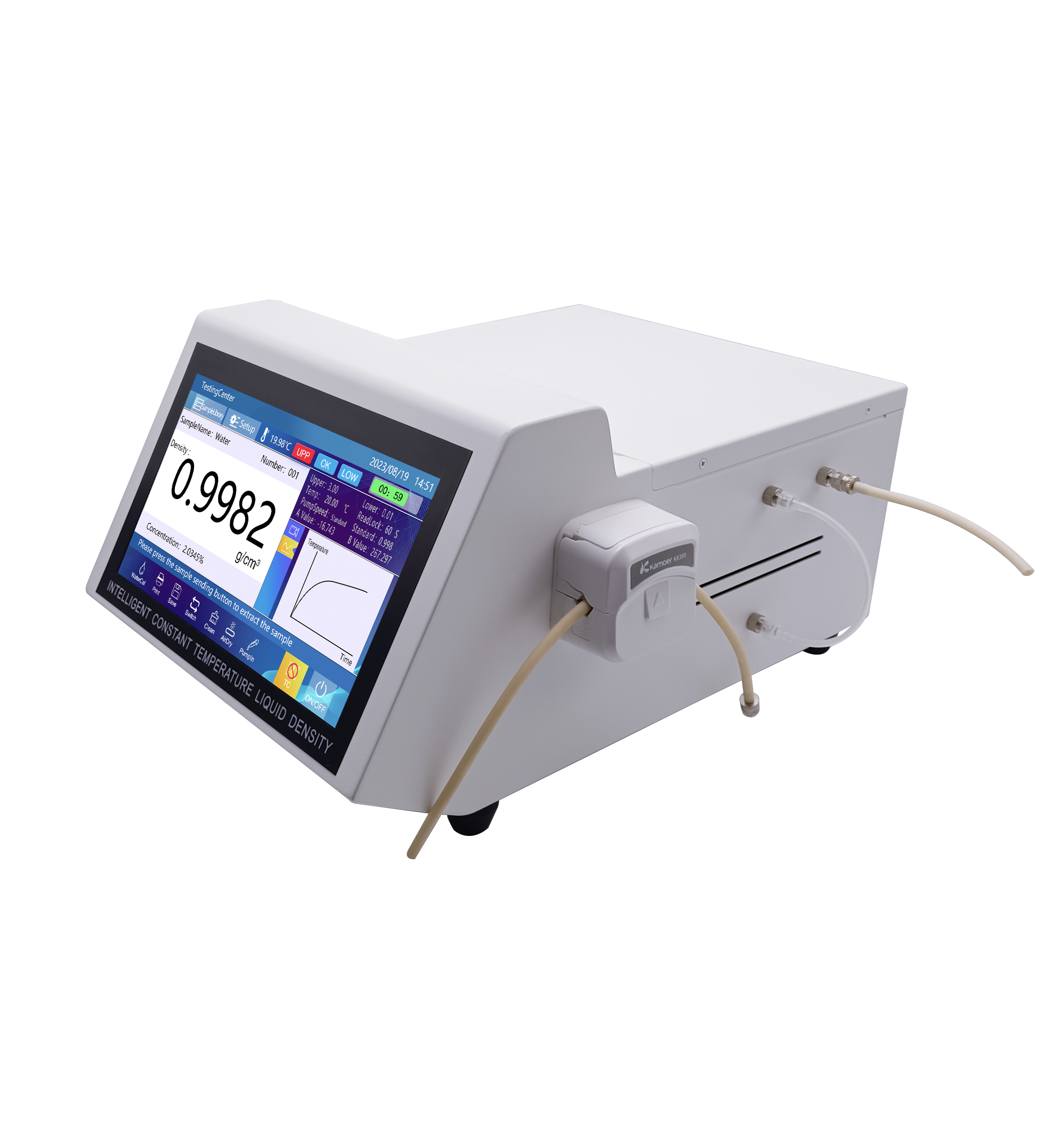
Residue from the previous oil can be just as disruptive as bubbles. Lubricants may vary considerably in viscosity and additive chemistry, so inadequate cleaning can allow one sample to influence the next. The ZG-MD80 includes automatic cleaning and a built-in drying air pump that dries the sample tubing after cleaning, reducing the amount of manual handling between measurements. Its stainless-steel connection design is also intended to support cleaning and reduce problems associated with contamination and bubble formation.
Dark or highly viscous oils still require careful procedures. Visual bubble monitoring is useful, but opaque samples can make bubble confirmation more difficult, and very viscous material may require an appropriate test temperature before it can fill the U-tube correctly. Laboratories should therefore validate sample preparation for the actual lubricant rather than assuming that automation eliminates every source of measurement error.
An oscillating U-tube density meter determines density by filling a calibrated tube with the sample and measuring how the tube's vibration changes. The instrument uses calibration data from fluids of known density to relate the measured oscillation behavior to sample density. This method reduces dependence on manually reading a liquid level or meniscus, while controlled temperature helps keep comparisons consistent. Oscillating U-tube measurement is widely used for petroleum products and lubricating oils in laboratory density testing.
For routine lubricant QC, the ZG-MD80 Fully Automatic Liquid Density Meter has a measurement range of 0–3 g/cm³, a density resolution of 0.00001 g/cm³, stated accuracy of ±0.0005 g/cm³, and repeatability of ±0.0002 g/cm³. It requires approximately 2 mL for manual injection or about 3 mL when using the automatic pump. Results can include density, relative density, temperature, concentration, and Baume degree, while the instrument can store 100 customized measurement methods and automatically save 100 sets of test values for statistical review.
No. | Sample Name | Sample ID | Date | Time | Temperature | Test Type | Measured Value | Test Type | Measured Value | Operator |
|---|---|---|---|---|---|---|---|---|---|---|
1 | Pure Water | 2 | 2026-06-23 | 14:22 | 20.0°C | Density | 0.9982 | Relative Density | 1.0000 | admin |
2 | Lubricating Oil | 3 | 2026-06-23 | 14:10 | 20.0°C | Density | 0.8572 | Relative Density | 0.8588 | admin |
3 | Lubricating Oil | 2 | 2026-06-23 | 14:05 | 20.0°C | Density | 0.8571 | Relative Density | 0.8587 | admin |
4 | Lubricating Oil | 1 | 2026-06-23 | 14:00 | 20.0°C | Density | 0.8573 | Relative Density | 0.8589 | admin |
5 | Pure Water | 1 | 2026-06-23 | 13:50 | 20.0°C | Density | 0.9982 | Relative Density | 1.0000 | admin |
These functions are useful when a laboratory tests several lubricant grades. Instead of relying on operators to remember different test conditions, individual methods can be established for specific sample groups. Statistical functions for average, maximum, and minimum values can also help distinguish an isolated unusual result from a repeated shift. The ZG-MD80 Fully Automatic Liquid Density Meter additionally provides RS232 and RJ45 connections, with SD card and other output options available for transferring or retaining laboratory records.
Some laboratories need a broader temperature range or a different accuracy level. A precision liquid density meter such as the ZG-MD90 operates from 5°C to 65°C and has stated density accuracy of ±0.0001 g/cm³ and repeatability of ±0.00005 g/cm³. That wider range can be relevant when an oil requires a higher temperature to remain sufficiently fluid for controlled testing. Instrument selection should therefore reflect actual lubricant viscosity, required temperature, internal precision needs, and laboratory procedures rather than model specifications alone.
Reliable lubricant density control begins with a repeatable procedure, not simply a more precise instrument. The laboratory should define the sampling location, container, mixing or homogenization requirements, test temperature, number of replicate measurements, acceptance window, and cleaning process. Reference or verification fluids should be handled under the laboratory's established quality system, while unusual readings should trigger a review of the sample and method before the batch itself is judged abnormal. This prevents sampling errors, bubbles, temperature differences, or residual material from being mistaken for genuine formulation changes.
Trend analysis is especially valuable. A single result within specification provides limited information, but a gradual movement toward one edge of the historical range can reveal a developing process change before a formal limit is exceeded. Laboratories can compare density with blending records and other physical or chemical measurements to determine whether the trend reflects raw materials, formulation adjustments, contamination, or normal variation. This makes density measurement part of a broader evidence-based QC process instead of an isolated number on a report.
Workflow requirements may also affect instrument choice. The automated density analyzer GD60 combines U-tube measurement with Peltier control from 5°C to 60°C, real-time bubble monitoring, automatic-compatible sample injection, data storage, multiple output interfaces, and a built-in drying function. Such features are relevant where laboratories prioritize structured records and repeated testing across many samples.
For the ZG-MD80 Fully Automatic Liquid Density Meter, automation is most useful when it reinforces a controlled method. Built-in sampling, cleaning, drying, temperature control, saved measurement programs, and result storage can reduce repetitive manual steps, but laboratories still need representative samples, suitable verification practices, and clearly defined acceptance criteria. Used in that way, automatic density measurement can improve consistency without encouraging operators to treat a single physical property as a complete assessment of lubricating oil quality.
Density measurement gives lubricant laboratories a practical way to monitor formulation consistency, compare batches, screen unusual samples, and support controlled quality decisions. The ZG-MD80 Fully Automatic Liquid Density Meter adds temperature control, U-tube measurement, visual sample monitoring, automated cleaning, and data functions that can make routine testing more consistent when used within a validated QC procedure. Shanghai Zhuoguang Instrument Technology Co., Ltd. is a scientific-instrument manufacturer whose density meter range supports laboratories with different temperature, accuracy, sample-handling, and record-management requirements.
A: Density helps laboratories compare raw materials and batches, identify unexpected physical changes, support mass-volume relationships, and decide when additional lubricant testing may be necessary.
A: No. Density is a screening and consistency parameter. Meaningful lubricant evaluation normally combines it with viscosity, water content, chemical condition, and other application-specific tests.
A: Oil volume changes with temperature, which changes density. Testing at a defined, stable temperature allows results from different samples and batches to be compared meaningfully.
A: It combines U-tube measurement, Peltier temperature control, automatic sampling, video observation, cleaning, drying, saved methods, and data storage to standardize repetitive laboratory steps.
A: Yes. Bubbles alter the contents of the measurement cell and can distort density readings, so proper sample filling and bubble checking remain important during testing.


