
- Home
- Products
- Hot Sales
- About Us
- Application
- Support
- News
- Contact
Views: 0 Author: Site Editor Publish Time: 2026-10-15 Origin: Site


Heating rate is an important factor in melting point determination. If a sample is heated too quickly, the measured melting range may differ from the result obtained under a validated method. This can affect repeatability, material identification, and quality control decisions.
For pharmaceutical and chemical laboratories, selecting a suitable melting point meter involves more than checking its maximum temperature. Laboratories should evaluate heating-rate control, temperature accuracy, sample throughput, data management, and compatibility with their test methods.
This guide explains how heating rate affects melting point results, what to consider when following pharmacopeial procedures, and which instrument features can support reliable laboratory workflows.
Table of Contents
Thermal lag occurs when the sample temperature does not keep pace with the temperature measured by the instrument. Heat must transfer from the heating block or bath through the capillary wall and into the sample. The delay depends on the instrument design, sample properties, capillary dimensions, and heating conditions.
Several factors can influence this process:
Heating block or bath: The instrument controls the temperature of its heating system. This reading does not always represent the sample's internal temperature.
Capillary wall: Heat must pass through the glass before reaching the sample.
Sample preparation: Particle size, packing, sample quantity, and moisture can affect heat transfer.
Heating rate: Faster heating can increase the temperature difference between the heating system and the sample.
When the temperature rises too quickly, the sample may not reach thermal equilibrium with the instrument. This can shift the observed melting temperature or broaden the melting range. The size and direction of the effect depend on the method and sample, so laboratories should verify results rather than assume a fixed correction.
Factor | Possible effect | Recommended control |
|---|---|---|
Heating rate | May affect the observed melting range | Follow the validated method |
Sample quantity | May change heat transfer through the sample | Use a consistent loading procedure |
Particle size and packing | May influence heat distribution | Prepare samples consistently |
Capillary dimensions | May affect heat transfer and comparability | Use the specified capillary type |
Moisture or impurities | May affect melting behavior | Prepare and store samples as required |
The heating rate affects how closely the measured result reflects the melting behavior of the material under the specified test conditions. A rate that is too fast for the method may reduce the comparability of results between tests or laboratories.
A wider melting range does not automatically prove that the heating rate is the only cause. Sample purity, particle size, moisture, packing, and the selected method can also affect the result. Laboratories should investigate these variables before changing the instrument settings.
For routine quality control, use the heating rate specified in the applicable monograph, standard, or validated procedure. Do not select a faster rate only to reduce testing time.
Pharmacopeial procedures define how melting point measurements should be performed for the relevant method. USP General Chapter <741> identifies factors such as sample size, particle size, heat diffusion, and heating rate as variables that need to be controlled. The European Pharmacopoeia's capillary method commonly uses a heating rate of about 1°C per minute unless otherwise prescribed. Requirements can vary by method and sample, so laboratories should consult the current applicable text.
Before purchasing a melting point meter, confirm that its operating range and heating-rate controls can support your laboratory's required procedures. Check whether the instrument allows the specified rate to be set and maintained, and whether temperature correction or calibration functions are available.
Electronic records and audit-trail functions may also be important in regulated laboratories. However, equipment features alone do not establish regulatory compliance. Confirm the complete instrument, software, configuration, and laboratory procedures against your applicable requirements.
Explore Zhuoguang's melting point apparatus range to compare available instrument types.
A programmable heating profile can help laboratories adapt the instrument to different testing tasks. The appropriate profile depends on the applicable method and the purpose of the measurement.
For routine release testing, follow the heating rate and sample-preparation requirements stated in the relevant method. If the method specifies a slow, controlled rate near the expected melting point, the instrument must be able to maintain that setting reliably.
For exploratory work, a faster initial ramp may help identify an approximate melting range. The result should be treated as preliminary if the procedure has not been validated for reporting purposes. A follow-up test should use the required method when an official or comparable result is needed.
Some samples change chemically during heating. In these cases, laboratories should use a method suitable for the material and document any observed decomposition. A faster ramp may reduce exposure time in some situations, but it can also change the observed thermal behavior. Do not assume that faster heating is appropriate without method development or verification.
When comparing instruments, check the available heating-rate range, adjustment increments, temperature control, and method storage options. For example, Zhuoguang's GM80 fully automatic melting point apparatus lists an adjustable heating rate of 0.1–20°C/min, PID temperature control, and capacity for four samples per batch. Confirm the specifications and configuration required for your application with the supplier.
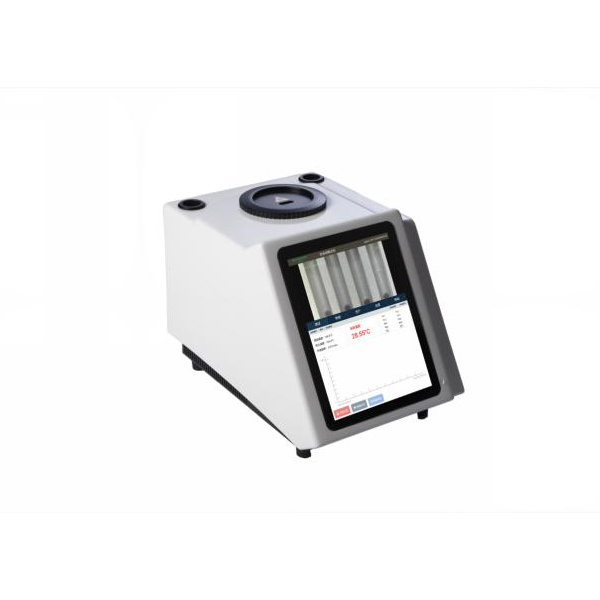
An automatic melting point apparatus from Zhuoguang Instrument. See the official melting point apparatus range for available models.
Even a well-controlled instrument cannot eliminate variation caused by inconsistent sample preparation. Follow the requirements of the applicable method and the instrument manufacturer's instructions.
Sample quantity: Use the sample amount or capillary fill height specified by the method. Do not apply one fill-height rule to every material and procedure.
Particle size: Prepare the sample as required. Large or uneven particles may affect heat distribution and the observed melting behavior.
Packing: Use a consistent procedure to create a compact sample column when required. Avoid differences in packing between replicate tests.
Moisture: Dry or condition the sample only when required by the method. Some materials may be affected by inappropriate drying or storage.
Capillaries: Use capillaries that meet the required dimensions and quality specifications. Keep the capillary type consistent when comparing results.
Record sample preparation conditions and investigate unexpected changes in the melting range before attributing them solely to the heating rate.
A suitable melting point meter should support the laboratory's actual test methods, sample volume, and documentation needs. Review the following points when comparing models.
Evaluation item | Questions to ask |
|---|---|
Heating-rate control | Can the instrument set and maintain the rates required by your methods? |
Temperature performance | What are the specified temperature resolution, accuracy, and correction functions? |
Sample throughput | How many samples can be measured in one batch? |
Observation and recording | Does the instrument record melting events or provide video observation? |
Data management | Are method storage, data export, user permissions, and audit trails available as required? |
Calibration and support | Can the supplier provide calibration guidance, technical documentation, and service support? |
For example, the GM80 product page lists automatic measurement, video observation, recording of initial and final melting, method storage, and data-management functions. Verify that the specific model and configuration meet your laboratory's requirements before purchase.
You can also browse Zhuoguang's product directory to compare other laboratory instruments.
Heating rate is a key variable in melting point determination, but it should not be considered in isolation. Sample preparation, capillary dimensions, temperature control, and the applicable test method can all affect the result.
For reliable measurements, follow the current applicable procedure, use consistent sample preparation, and verify instrument performance through suitable calibration and quality-control practices. When selecting a melting point meter, compare heating-rate flexibility, temperature performance, sample capacity, data functions, and technical support against your laboratory's needs.
A heating rate that is too fast for the method can affect the observed melting temperature and melting range because the sample may not keep pace with the instrument's heating system. The effect depends on the sample and test conditions.
No. The correct rate depends on the applicable pharmacopeial method, monograph, or validated procedure. Around 1°C/min is common for some capillary methods, but laboratories must verify the current requirements for their specific test.
A faster ramp may be useful for preliminary screening when the method permits it. Treat the result as exploratory unless the procedure has been validated for the intended purpose. Use the required method for reportable results.
Possible causes include heating rate, sample purity, particle size, moisture, sample quantity, packing, and capillary differences. Review these factors systematically instead of assuming that heating rate is the only cause.
Check heating-rate control, temperature performance, sample capacity, observation and recording functions, data-management requirements, calibration support, and compatibility with your laboratory's methods.


