
- Home
- Products
- Hot Sales
- About Us
- Application
- Support
- News
- Contact
Views: 0 Author: Site Editor Publish Time: 2026-08-04 Origin: Site


For laboratories checking tobacco flavor consistency, relative density is meaningful only when temperature, sample filling, and bubble control are handled consistently. The ZG-MD60 Fully Automatic Liquid Density Meter combines an oscillating U-tube measurement system with Peltier temperature control, visual observation, and automated fluid handling. A practical 20°C method therefore involves more than injecting a liquid and reading a number. Cleanliness, complete filling, temperature equilibrium, bubble exclusion, and effective cleaning between samples all influence whether the final relative-density result is useful for routine quality evaluation.
Relative density describes a ratio rather than an absolute density value. For tobacco flavor testing at 20°C, it represents the mass of a given volume of the flavor sample compared with the mass of the same volume of distilled water at 20°C. Because both quantities are compared at the same reference temperature, the result is dimensionless. This distinction matters when laboratory records contain both density in g/cm³ and relative density, because the two values are related but should not be treated as interchangeable.
Temperature control is central to the measurement because liquid density changes as a sample expands or contracts. A flavor tested at one temperature cannot be compared directly with a specification defined at another temperature without an appropriate correction. For work organized around a 20°C relative-density method, both the measurement system and the sample inside the measuring tube should reach the required temperature before the result is accepted. Allowing the instrument to stabilize also reduces variation caused by continuously changing sample temperature during the measurement.
The ZG-MD60 Fully Automatic Liquid Density Meter has a Peltier-controlled temperature range of 15°C to 40°C with a stated temperature resolution of 0.01°C, allowing 20°C to be selected directly as the measurement temperature. Its display can show density, relative density, temperature, concentration, and Baumé degree, so the laboratory should confirm that the correct result type is being recorded for the method being followed.
An oscillating U-tube density meter determines density from the behavior of a liquid-filled measuring tube. The sample is introduced into a temperature-controlled U-shaped glass tube that can oscillate under controlled excitation. In a simplified spring-oscillator model, the oscillation period can be represented by T = 2π√(m/k), where the effective mass changes when a different liquid fills the tube. Measuring that change in oscillation behavior allows the instrument to determine the liquid density after calibration with fluids of known density.
This approach eliminates the need to weigh separate equal-volume portions of water and flavor manually during every routine measurement. Instead, the tube constant is established through calibration, the sample is brought to the selected temperature, and the instrument evaluates the oscillation period or frequency. For relative-density testing, the resulting density can then be related to the defined water reference at the same temperature. The important condition is that the measuring tube must contain only the intended sample, without air pockets, cleaning liquid, residual water, or material left from the previous test.
The ZG-MD60 Density Meter uses the U-shaped vibration tube method and supports both manual syringe injection and automatic sampling through a built-in pump. Its stated density range is 0–3 g/cm³, with 0.0001 g/cm³ resolution, ±0.0003 g/cm³ repeatability, and ±0.0008 g/cm³ accuracy. These specifications describe the instrument itself; laboratories should still compare instrument capability with their own method requirements, acceptance limits, and quality-control procedures before establishing a routine test.
Begin with a clean, dry measuring tube and confirm that the density meter is operating under the intended method settings. For tobacco flavor relative-density testing at 20°C, set the measurement temperature to 20°C and allow the temperature-control system to stabilize. A sample that is already reasonably close to the target temperature generally reaches equilibrium more efficiently than one entering the measuring cell with a large temperature difference. Avoid unnecessary agitation before testing because vigorous shaking can introduce fine bubbles that may remain suspended in some flavor formulations.
The measuring tube should also be checked for residues before the first sample and whenever the previous material differs significantly in composition. A transparent liquid can still leave a film that changes the effective condition of the U-tube, while residual cleaning liquid can dilute the next sample. With the ZG-MD60 Fully Automatic Liquid Density Meter, cleaning and drying functions can be incorporated into the routine method, but the operator should still verify that the tube condition is suitable before beginning a new sequence.
Introduce enough sample to replace the previous contents completely and fill the measuring section without trapped air. The ZG-MD60 Fully Automatic Liquid Density Meter uses approximately 2 mL for manual syringe injection and approximately 3 mL during automatic-pump sampling. Manual filling should be steady rather than abrupt, especially with viscous or bubble-prone flavors, because rapid injection can introduce air or create discontinuities in the liquid column. Automatic sampling can improve procedural consistency, but visual confirmation remains valuable before accepting the measurement.

Air bubbles are one of the most important practical error sources in an oscillating U-tube. Even a small bubble changes the material filling the tube and can disturb its oscillation behavior, producing a result that does not represent the homogeneous liquid sample. The instrument's video function provides a direct way to inspect the measuring area, so the operator can reject and refill a sample when bubbles remain visible. This visual step closely supports the fundamental method requirement that the U-tube be completely filled and free from adhered bubbles.
After filling, allow the sample to reach the selected 20°C condition before recording the final result. A density value that continues to move while temperature is still changing should not be treated as the completed measurement. The ZG-MD60 Fully Automatic Liquid Density Meter allows stability criteria to be configured according to measurement accuracy and time, which can help standardize the point at which results are accepted. Its stated measuring time depends partly on sample temperature, so rushing the equilibration stage can reduce the usefulness of an otherwise automated procedure.
Once a stable result is obtained, record the relative-density value together with the sample identification and measurement temperature required by the laboratory procedure. If replicate measurements are part of the internal method, compare them before releasing the result rather than relying on a single value automatically. The ZG-MD60 system can store test values and calculate average, maximum, and minimum values, which can support routine review when repeated determinations are required.
Cleaning between different tobacco flavor samples is not merely a housekeeping step. Residual flavor components can mix with the next sample, while remaining rinse liquid can change its composition and density. The cleaning agent and sequence should therefore be suitable for removing the previous material without leaving a persistent residue in the measuring path. After cleaning, the measuring tube must be sufficiently dry before the next sample is introduced.
The ZG-MD60 Fully Automatic Liquid Density Meter includes an injection pump for automatic sampling and cleaning and a built-in drying air pump for drying the sample tube after cleaning. These functions can reduce differences between operators, but automated cleaning should still be verified periodically, particularly when moving between samples with substantially different viscosity or composition.
Sample Density and Relative-Density Measurement Results
The following measurement records illustrate density and relative-density results obtained from different flavor-related samples. Repeated measurements help laboratories evaluate result consistency and compare the physical properties of different formulations.
Sample Name | Density (g/cm³) | Relative Density |
|---|---|---|
Coffee Extract | 1.2354 | 1.237 |
Coffee Extract | 1.2355 | 1.237 |
Fig Extract | 1.2737 | 1.2760 |
Fig Extract | 1.2737 | 1.2760 |
Diluted Grape Oil | 0.9046 | 0.9062 |
Diluted Grape Oil | 0.9046 | 0.9062 |
Cocoa Ester | 1.0068 | 1.104 |
Cocoa Ester | 1.0065 | 1.1015 |
Carob Extract | 1.3922 | 1.3948 |
Carob Extract | 1.3923 | 1.3948 |
Yeast Extract | 1.3839 | 1.3864 |
Yeast Extract | 1.3840 | 1.3865 |
 |  |
 |  |
Several problems can produce a plausible-looking number while still weakening the measurement. Temperature mismatch is especially easy to overlook because the display may already show density even though the sample has not fully equilibrated. Air bubbles usually produce more obvious instability, but very small bubbles may remain attached to the tube wall and require visual inspection. Carryover, residual rinse liquid, incomplete drying, and an incorrectly selected result mode can also create systematic differences that may persist across a batch.
Measurement Issue | Possible Effect | Practical Control |
|---|---|---|
Sample not stabilized at 20°C | Density shifts with changing temperature | Wait for thermal and measurement stability |
Bubble trapped in the U-tube | Nonrepresentative oscillation behavior | Inspect the tube and refill if necessary |
Previous sample remains in the path | Carryover changes sample composition | Run an effective cleaning sequence |
Rinse liquid remains after cleaning | Dilution or contamination of the next sample | Dry the measuring tube completely |
Sample is injected too rapidly | Bubbles or incomplete filling may occur | Use steady manual filling or controlled automatic sampling |
Density is recorded instead of relative density | Wrong property entered in the report | Confirm the selected measurement mode before recording |
Good control therefore depends on a repeatable sequence rather than a single instrument specification. The same sample should be introduced consistently, measured at the same defined temperature, checked for bubbles, and recorded using the same result mode. Calibration and instrument checks should follow the laboratory's established schedule, while unexpected shifts should trigger inspection of the measuring tube and fluid-handling path before assuming that the flavor itself has changed. The ZG-MD60 Fully Automatic Liquid Density Meter supports several of these control points through temperature regulation, video observation, automated sampling, cleaning, drying, method storage, and result storage.
A 20°C tobacco flavor method does not automatically require the instrument with the smallest available resolution. Selection should consider the required acceptance tolerance, expected sample range, temperature conditions, workload, data-management needs, and the difficulty of cleaning the samples being tested. For routine relative-density work, the most useful features are often stable temperature control, clear bubble observation, reproducible sample introduction, and effective cleaning between different formulations. Resolution and stated accuracy should then be matched to the actual analytical requirement instead of being evaluated in isolation.
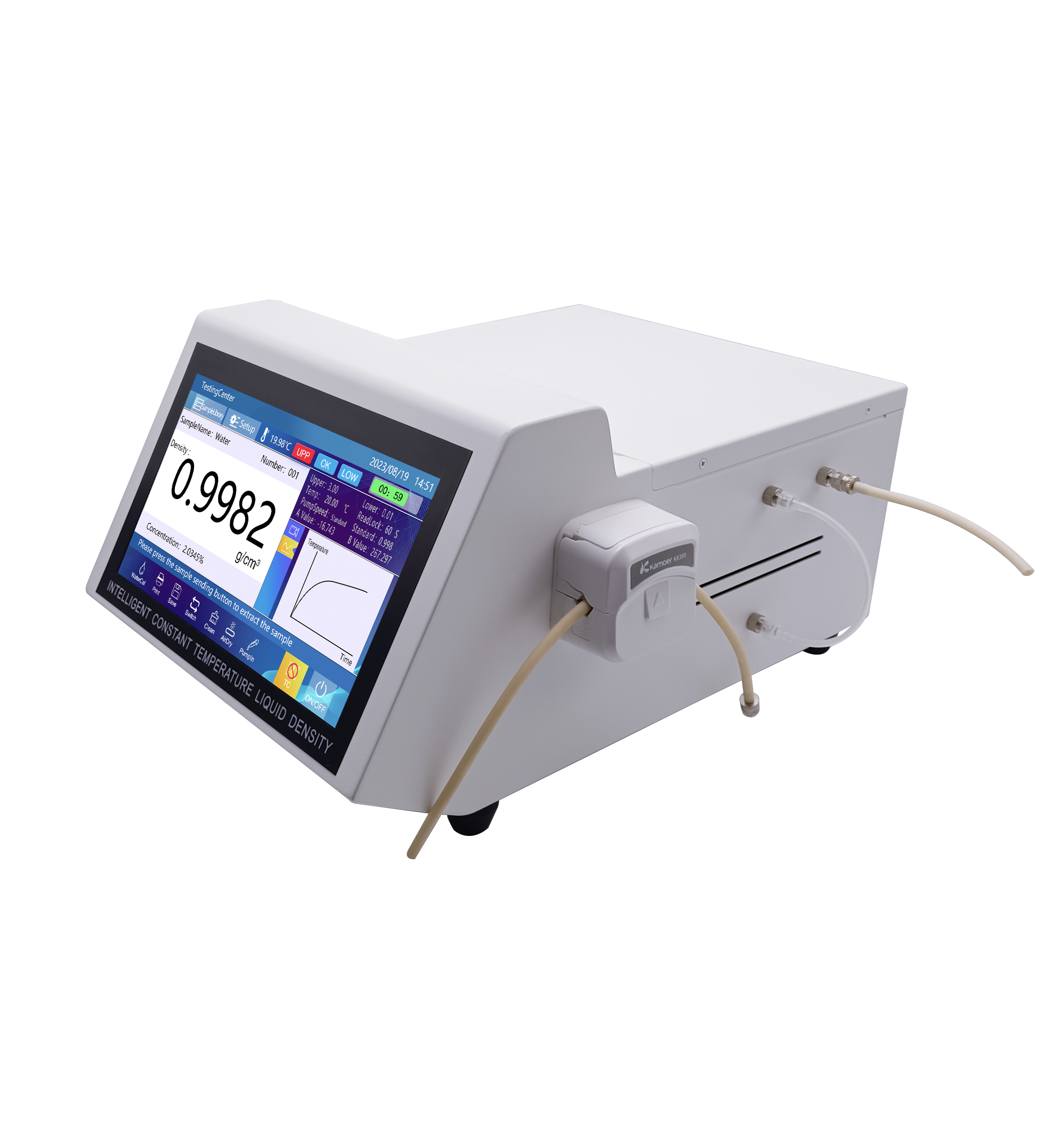
Shanghai Zhuoguang offers several automatic liquid density meter configurations with different stated specifications. The ZG-MD60 Fully Automatic Liquid Density Meter covers the 20°C tobacco flavor workflow and combines Peltier temperature control, video inspection, automatic sampling, cleaning, and drying. The GD60 Density Meter provides a wider stated temperature-control range, while the ZG-MD80 Density Meter provides a finer stated density resolution. The appropriate configuration depends on the laboratory's method rather than on specification magnitude alone.
Model | Density Resolution | Stated Accuracy | Temperature Range | Relevant Workflow Features |
|---|---|---|---|---|
ZG-MD60 | 0.0001 g/cm³ | ±0.0008 g/cm³ | 15–40°C | Automatic sampling, video inspection, cleaning and drying |
GD60 | 0.0001 g/cm³ | ±0.0003 g/cm³ | 5–60°C | Automatic injection, real-time bubble monitoring and drying |
ZG-MD80 | 0.00001 g/cm³ | ±0.0005 g/cm³ | 10–45°C | Automatic sampling, video inspection, cleaning and drying |
The comparison is most useful as a screening step. Before establishing a method, laboratories should verify that the selected instrument range, temperature capability, sampling mode, and performance specifications satisfy their own procedure and acceptance criteria. For tobacco flavor relative density specifically, maintaining the 20°C reference condition and controlling bubbles and carryover remain essential regardless of which automatic density meter configuration is selected.
Reliable tobacco flavor relative-density measurement depends on controlling the entire procedure: a clean and dry U-tube, complete bubble-free filling, a stable 20°C measurement condition, correct result selection, and effective cleaning between samples. The ZG-MD60 Fully Automatic Liquid Density Meter supports these steps through U-tube oscillation measurement, Peltier temperature control, video inspection, automated fluid handling, and data functions. Shanghai Zhuoguang Instrument Technology Co., Ltd. is a laboratory instrument manufacturer whose density-meter configurations can be evaluated against specific testing ranges, workflow requirements, and laboratory acceptance criteria.
A: It is the ratio between the mass of a defined volume of tobacco flavor and the mass of the same volume of distilled water, both evaluated at 20°C.
A: Yes. The ZG-MD60 display includes density and relative-density values, while its Peltier system allows the measurement temperature to be set at 20°C.
A: Bubbles replace part of the liquid inside the oscillating U-tube and can alter its vibration behavior, causing the measured value to differ from the homogeneous sample.
A: Its stated sampling volume is approximately 2 mL with manual syringe injection and approximately 3 mL when the built-in automatic pump is used.
A: Proper cleaning removes carryover from the previous sample, while complete drying prevents residual rinse liquid from diluting or contaminating the next sample entering the U-tube.


