
- Home
- Products
- Hot Sales
- About Us
- Application
- Support
- News
- Contact
Views: 0 Author: Site Editor Publish Time: 2026-01-15 Origin: Site


The GT80 Fully Automatic Potential Titrator is a state-of-the-art instrument designed for precise analysis in the chemical and electronic industries. One of the primary applications of the GT80 is the automated potentiometric titration of carbonate ions, a critical task in various chemical and environmental testing, particularly in the context of developing solutions for electronic manufacturing.
This article explores the automatic potentiometric titration method for determining carbonate ions, with a focus on how the GT80 simplifies and enhances this process. We will discuss the principles of the titration, the benefits of automation. We’ll also examine the technical capabilities of the GT80 Automatic Potential Titrator and how it ensures precision in complex analyses.
Potentiometric titration is a technique in analytical chemistry used to determine the concentration of a substance in a solution by measuring the change in potential (voltage) as a reagent is added. The GT80 Automatic Potential Titrator automates this process to provide high precision in various titration applications, including the determination of carbonate ions.
In a typical potentiometric titration, a reference electrode and an indicator electrode are immersed in the sample solution. The voltage is measured as the titrant is added, and the resulting potential changes are used to identify the endpoint of the titration—this is where the quantity of titrant added corresponds to the completion of the reaction.
Carbonate ions (CO₃⊃2;⁻) are commonly found in many industrial processes, including in developing solutions used in the electronics industry. The standard potentiometric titration for carbonate ion concentration in these solutions involves titrating with hydrochloric acid (HCl). The titration process follows these steps:
Initial Adjustment: A sample of the developing solution is initially pre-neutralized with a strong acid (HCl) to adjust the pH to around 11.
Titration: The sample is then titrated using two different concentrations of HCl. During the titration, the first sharp potential change is observed when hydroxide ions (OH⁻) react with hydrogen ions (H⁺) to form water. The second potential jump is the reaction between carbonate ions and hydrogen ions to form carbonic acid. The final jump corresponds to the completion of the titration process, marking the point at which the carbonate ions have fully reacted.
The GT80 Titrator ensures that these steps are carried out automatically with precise control over the reagent addition, ensuring accuracy and minimizing human error.
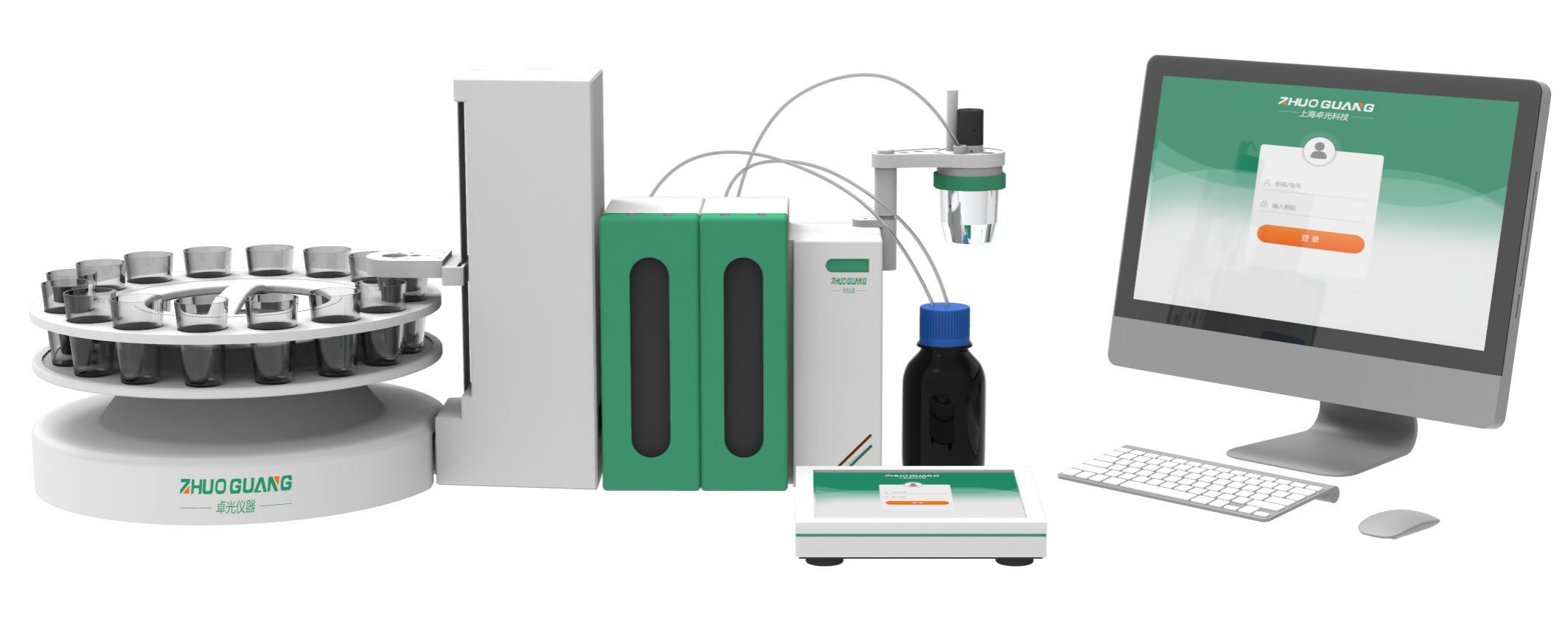
The GT80 Automatic Potential Titrator offers several advantages that make it an essential tool for laboratories and industries dealing with precise titration processes.
The GT80 employs a sophisticated control system to manage the titration process automatically. This results in precise endpoint detection, even for complex reactions like carbonate ion determination in developing solutions. By automating the process, it eliminates human error and ensures reproducibility in results.
Automating potentiometric titration processes reduces the manual workload for lab technicians. The GT80 offers a fully automated titration process, from sample preparation to the final result, allowing labs to increase throughput and efficiency.
The GT80 comes with an intuitive user interface, which simplifies the process of setting up titration protocols. Users can select from preset methods or create custom titration procedures tailored to specific applications like carbonate ion analysis. The system provides real-time feedback, ensuring that users can monitor the titration in progress.
The GT80 automatically logs all titration data, which is crucial for traceability and reporting. The results are saved in formats compatible with common analysis software, allowing for easy export and integration with other systems.
In the electronics industry, carbonate ions are often present in developing solutions. Accurate determination of these ions is essential to ensure the quality of the solution and to meet industry standards.
Sample Preparation: The sample, such as a developing solution, is first weighed and placed in a closed vessel. The solution is then neutralized with a strong acid (HCl) to adjust the pH to around 11.
Titration Procedure: The GT80 is set up to titrate the sample using a two-step HCl titration, adjusting the concentration of the acid based on the sample's characteristics. The system automatically detects the endpoint, which corresponds to the change in potential as the carbonate ions are fully reacted.
The concentration of carbonate ions in the sample is determined by calculating the volume of acid consumed at specific potential jumps (EP1 and EP2), which mark the reaction of hydroxide ions and carbonate ions with hydrogen ions, respectively. Using the volume of titrant consumed, the concentration of carbonate ions can be calculated as follows:
ω=(V2−V1)×c×Mm\omega = \frac{(V_2 - V_1) \times c \times M}{m}ω=m(V2−V1)×c×M
Where:
V2V_2V2 is the volume of HCl at the second endpoint (EP2).
V1V_1V1 is the volume of HCl at the first endpoint (EP1).
ccc is the concentration of the HCl titrant.
MMM is the molar mass of carbonate ions.
mmm is the mass of the sample.
The GT80 simplifies this calculation by automatically processing the titration data and providing the concentration result in real-time.


The GT80 Fully Automatic Potential Titrator represents the forefront of automation in analytical chemistry. Its application in potentiometric titration, especially for carbonate ion determination in solutions used in the electronics industry, provides significant benefits in terms of accuracy, precision, and efficiency. With its easy-to-use interface, precise endpoint detection, and automated data logging, the GT80 is an invaluable tool for laboratories and industries involved in high-precision chemical analysis.
For anyone in the field of industrial chemistry, particularly those working with carbonate ions in developing solutions, the GT80 provides a reliable and accurate solution to automate and enhance your titration processes. This cutting-edge technology ensures compliance with industry standards and significantly reduces human error, providing trustworthy results every time.


