
- Home
- Products
- Hot Sales
- About Us
- Application
- Support
- News
- Contact
Views: 0 Author: Site Editor Publish Time: 2026-01-20 Origin: Site


Sesame oil is a widely used cooking oil known for its unique flavor and health benefits. One of the key indicators of its quality and freshness is the acid value (also known as acidity, acid number, or acid index). The acid value reflects the amount of free fatty acids in the oil, which can be an indicator of the oil's quality, age, and storage conditions. A higher acid value indicates a more degraded oil, often due to hydrolysis or rancidity.
In this blog post, we will explore the potentiometric titration method for measuring the acid value in sesame oil. We will focus on how the GT80 Fully Automatic Potential Titrator can simplify this process, ensuring accurate and efficient results. This method is not only ideal for quality control in the food industry but also essential for meeting international food safety standards.
The acid value of edible oils, such as sesame oil, is an important quality parameter. It quantifies the amount of free fatty acids (mainly oleic acid, linoleic acid, and other long-chain fatty acids) present in the oil. These fatty acids are released when triglycerides in the oil break down, either during oil extraction or due to improper storage conditions.
Freshness and Quality: A low acid value indicates that the oil is fresh and of high quality, with minimal degradation.
Storage Conditions: A high acid value is often a sign of poor storage conditions or oil spoilage due to exposure to air, heat, or light.
Hydrolysis Indicator: The acid value can also serve as an indicator of the extent of hydrolysis that has occurred during oil production or storage.
Rancidity: Oils with high acid values are more likely to be rancid, affecting flavor and safety.
Given its importance, accurate determination of the acid value is crucial for manufacturers, consumers, and regulatory bodies to ensure product quality and safety.
Potentiometric titration is an advanced analytical technique widely used in food testing, particularly for measuring the acid value in oils and fats. This method involves titrating a sample with a base (such as sodium hydroxide) and measuring the resulting change in the solution's pH to determine the endpoint.
The GT80 Fully Automatic Potential Titrator is an advanced instrument designed to automate the potentiometric titration process. It ensures precision, accuracy, and efficiency, making it ideal for routine testing of acid value in oils like sesame oil. The GT80 automates the titration process, significantly reducing human error and improving repeatability.
Sample Preparation: In this method, an equal volume of isopropanol and ether is used as a solvent. Approximately 10 grams of sesame oil is weighed and placed into a beaker.
Dissolution: 50 mL of the solvent mixture is added to dissolve the oil, and the mixture is stirred thoroughly.
Titration: The sample is titrated with sodium hydroxide solution (0.1 mol/L) until the endpoint is reached, with the GT80 ensuring precise control over the titrant volume.
Blank Test: A blank titration is performed to subtract the influence of any impurities in the reagents and solvents.
The GT80 Automatic Potential Titrator is capable of performing this titration with high precision, allowing operators to obtain consistent and accurate results for the acid value.
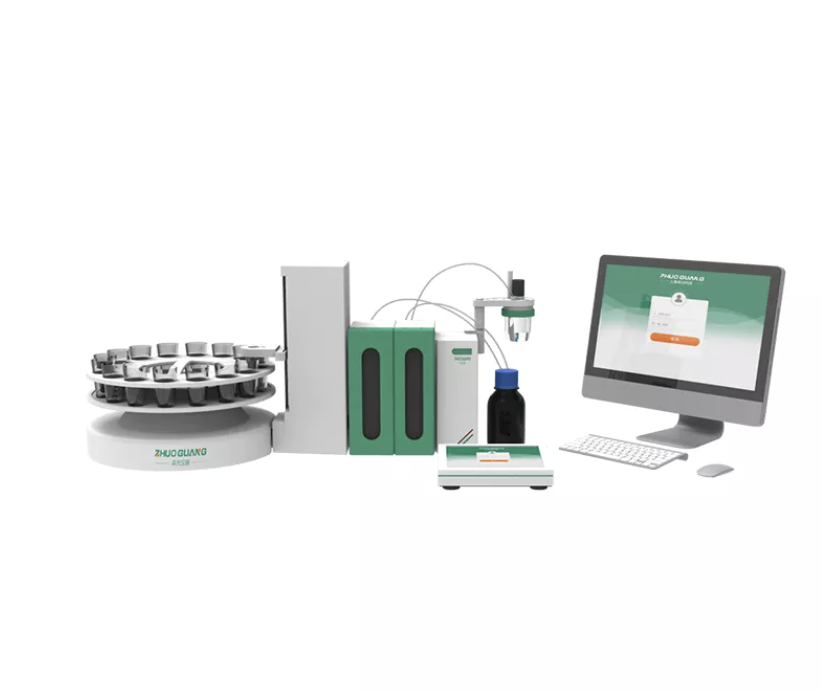
When performing potentiometric titration, the following parameters are set to ensure optimal titration conditions:
Titration Mode: Dynamic titration.
Stirring Speed: 5.
Electrode Balance Time: 4 seconds.
Pre-Stirring Time: 6 seconds.
Electrode Balance Potential: 1 mV.
Titration Speed: Standard.
Minimum Titrant Addition: 0.02 mL.
Pre-Titration Volume: 0.02 mL.
End Volume: 10 mL.
Pre-Titration Stirring Time: 8 seconds.
pH Jump Threshold: 400 mV.
Pre-Control pH: 9.0.
These parameters ensure that the titration process is efficient, accurate, and reliable, with minimal interference from the sample matrix.
Once the titration is completed, the acid value in the sesame oil sample is calculated using the following formula:
X=(V1−V0)×C×40mX = \frac{{(V1 - V0) \times C \times 40}}{{m}}X=m(V1−V0)×C×40
Where:
X is the acid value (mg/g).
V1 is the volume of sodium hydroxide used in the sample titration (mL).
V0 is the volume of sodium hydroxide used in the blank titration (mL).
C is the concentration of the sodium hydroxide solution (mol/L).
m is the sample mass (g).
For a sesame oil sample weighing 10.3738 grams, the following titration results were obtained:
Titration Volume (V1): 0.911 mL.
Blank Volume (V0): 0.292 mL.
Sodium Hydroxide Concentration (C): 0.1 mol/L.
Using the formula, the acid value can be calculated as:
X=(0.911−0.292)×0.1×4010.3738=0.219 mg/gX = \frac{{(0.911 - 0.292) \times 0.1 \times 40}}{{10.3738}} = 0.219 \, \text{mg/g}X=10.3738(0.911−0.292)×0.1×40=0.219mg/g
This result is consistent across multiple trials, indicating the precision and repeatability of the method.

The GT80 ensures high precision and reproducibility in measuring acid value, which is critical for quality control in the food industry. By automating the titration process, it eliminates human errors and provides consistent results across multiple measurements.
Automated titration with the GT80 reduces analysis time and increases throughput. This is especially beneficial in industrial settings where large volumes of samples need to be tested quickly and accurately.
The method aligns with international food safety standards, such as GB 5009.229-2016, for measuring acid value in food products. This ensures that manufacturers can comply with regulatory requirements and provide safe, high-quality products to consumers.
The GT80 Automatic Potential Titrator features an intuitive user interface, making it easy to set up and operate. Operators can configure the titration process, monitor progress in real-time, and receive automatic results, all with minimal training.
In a series of titrations of sesame oil samples, the acid values were consistently measured with a small variation between trials, demonstrating the reliability and repeatability of the potentiometric titration method. The results are shown in the table below:
| Sample | Sample Mass (g) | Titration Volume (mL) | Acid Value (mg/g) |
|---|---|---|---|
| Sesame Oil 1 | 10.3738 | 0.911 | 0.219 |
| Sesame Oil 2 | 10.5651 | 0.921 | 0.218 |
| Sesame Oil 3 | 10.3012 | 0.908 | 0.219 |
These results demonstrate that the GT80 provides reliable, accurate, and consistent measurements for acid value determination.
The GT80 Fully Automatic Potential Titrator is a powerful tool for determining the acid value in sesame oil and other edible oils. By automating the titration process, it ensures high precision, reduces human error, and speeds up the analysis. This makes it an invaluable instrument for quality control in the food industry, helping manufacturers ensure the freshness, safety, and quality of their products.
For those looking to enhance their oil quality testing processes, the GT80 Automatic Potential Titrator offers a reliable, efficient, and compliant solution.


